
The Heroes, by Charles Kingsley
Author: Sticky Mix Source: Coloring Books Views: 【L M S】 Published:2026-07-29 22:24:40 Comments:
Transcribed from the 1889 Macmillan and crib toys for 6 months under 100 dollarsCo. edition by DavidPrice, email [email protected]
THE HEROES,
or
GREEK FAIRY TALES
FOR MY CHILDREN
by
CHARLES KINGSLEY
illustrated
london:
MACMILLAN AND CO.
and new york
1889
The right of translation ifreserved
Printed byR. & R. Clark, Edinburgh.
to
MY CHILDREN
ROSE, MAURICE, AND MARY
a littlepresent
of old greek fairy tales
PREFACE
My Dear Children,
Some of you have heard already of the old Greeks; and all ofyou, as you grow up, will hear more and more of them. Thoseof you who are boys will, perhaps, spend a great deal of time inreading Greek books; and the girls, though they may not learnGreek, will be sure to come across a great many stories takenfrom Greek history, and to see, I may say every day, things whichwe should not have had if it had not been for these oldGreeks. You can hardly find a well-written book which hasnot in it Greek names, and words, and proverbs; you cannot walkthrough a great town without passing Greek buildings; you cannotgo into a well-furnished room without seeing Greek statues andornaments, even Greek patterns of furniture and paper; sostrangely have these old Greeks left their mark behind them uponthis modern world in which we now live. And as you grow up,and read more and more, you will find that we owe to these oldGreeks the beginners of all our mathematics andgeometry—that is, the science and knowledge of numbers, andof the shapes of things, and of the forces which make things moveand stand at rest; and the beginnings of our geography andastronomy; and of our laws, and freedom, and politics—thatis, the science of how to rule a country, and make it peacefuland strong. And we owe to them, too, the beginning of ourlogic—that is, the study of words and of reasoning; and ofour metaphysics—that is, the study of our own thoughts andsouls. And last of all, they made their language sobeautiful that foreigners used to take to it instead of theirown; and at last Greek became the common language of educatedpeople all over the old world, from Persia and Egypt even toSpain and Britain. And therefore it was that the NewTestament was written in Greek, that it might be read andunderstood by all the nations of the Roman empire; so that, nextto the Jews, and the Bible which the Jews handed down to us, weowe more to these old Greeks than to any people upon earth.
Now you must remember one thing—that‘Greeks’ was not their real name. They calledthemselves always ‘Hellens,’ but the Romans miscalledthem Greeks; and we have taken that wrong name from theRomans—it would take a long time to tell you why. They were made up of many tribes and many small separate states;and when you hear in this book of Minuai, and Athenians, andother such names, you must remember that they were all differenttribes and peoples of the one great Hellen race, who lived inwhat we now call Greece, in the islands of the Archipelago, andalong the coast of Asia Minor (Ionia, as they call it), from theHellespont to Rhodes, and had afterwards colonies and cities inSicily, and South Italy (which was called Great Greece), andalong the shores of the Black Sea at Sinope, and Kertch, and atSevastopol. And after that, again, they spread underAlexander the Great, and conquered Egypt, and Syria, and Persia,and the whole East. But that was many hundred years aftermy stories; for then there were no Greeks on the Black Seashores, nor in Sicily, or Italy, or anywhere but in Greece and inIonia. And if you are puzzled by the names of places inthis book, you must take the maps and find them out. Itwill be a pleasanter way of learning geography than out of a dulllesson-book.
Now, I love these old Hellens heartily; and I should be veryungrateful to them if I did not, considering all that they havetaught me; and they seem to me like brothers, though they haveall been dead and gone many hundred years ago. So as youmust learn about them, whether you choose or not, I wish to bethe first to introduce you to them, and to say, ‘Comehither, children, at this blessed Christmas time, when allGod’s creatures should rejoice together, and bless Him whoredeemed them all. Come and see old friends of mine, whom Iknew long ere you were born. They are come to visit us atChristmas, out of the world where all live to God; and to tellyou some of their old fairy tales, which they loved when theywere young like you.’
For nations begin at first by being children like you, thoughthey are made up of grown men. They are children at firstlike you—men and women with children’s hearts; frank,and affectionate, and full of trust, and teachable, and loving tosee and learn all the wonders round them; and greedy also, toooften, and passionate and silly, as children are.
Thus these old Greeks were teachable, and learnt from all thenations round. From the Phoenicians they learntshipbuilding, and some say letters beside; and from the Assyriansthey learnt painting, and carving, and building in wood andstone; and from the Egyptians they learnt astronomy, and manythings which you would not understand. In this they werelike our own forefathers the Northmen, of whom you love to hear,who, though they were wild and rough themselves, were humble, andglad to learn from every one. Therefore God rewarded theseGreeks, as He rewarded our forefathers, and made them wiser thanthe people who taught them in everything they learnt; for Heloves to see men and children open-hearted, and willing to betaught; and to him who uses what he has got, He gives more andmore day by day. So these Greeks grew wise and powerful,and wrote poems which will live till the world’s end, whichyou must read for yourselves some day, in English at least, ifnot in Greek. And they learnt to carve statues, and buildtemples, which are still among the wonders of the world; and manyanother wondrous thing God taught them, for which we are thewiser this day.
For you must not fancy, children, that because these oldGreeks were heathens, therefore God did not care for them, andtaught them nothing.
The Bible tells us that it was not so, but that God’smercy is over all His works, and that He understands the heartsof all people, and fashions all their works. And St. Paultold these old Greeks in after times, when they had grown wickedand fallen low, that they ought to have known better, becausethey were God’s offspring, as their own poets had said; andthat the good God had put them where they were, to seek the Lord,and feel after Him, and find Him, though He was not far from anyone of them. And Clement of Alexandria, a great Father ofthe Church, who was as wise as he was good, said that God hadsent down Philosophy to the Greeks from heaven, as He sent downthe Gospel to the Jews.
For Jesus Christ, remember, is the Light who lights every manwho comes into the world. And no one can think a rightthought, or feel a right feeling, or understand the real truth ofanything in earth and heaven, unless the good Lord Jesus teacheshim by His Spirit, which gives man understanding.
But these Greeks, as St. Paul told them, forgot what God hadtaught them, and, though they were God’s offspring,worshipped idols of wood and stone, and fell at last into sin andshame, and then, of course, into cowardice and slavery, till theyperished out of that beautiful land which God had given them forso many years.
For, like all nations who have left anything behind them,beside mere mounds of earth, they believed at first in the OneTrue God who made all heaven and earth. But after a while, likeall other nations, they began to worship other gods, or ratherangels and spirits, who (so they fancied) lived about theirland. Zeus, the Father of gods and men (who was some dimremembrance of the blessed true God), and Hera his wife, andPhoebus Apollo the Sun-god, and Pallas Athené who taughtmen wisdom and useful arts, and Aphrodite the Queen of Beauty,and Poseidon the Ruler of the Sea, and Hephaistos the King of theFire, who taught men to work in metals. And they honouredthe Gods of the Rivers, and the Nymph-maids, who they fanciedlived in the caves, and the fountains, and the glens of theforest, and all beautiful wild places. And they honouredthe Erinnues, the dreadful sisters, who, they thought, hauntedguilty men until their sins were purged away. And manyother dreams they had, which parted the One God into many; andthey said, too, that these gods did things which would be a shameand sin for any man to do. And when their philosophersarose, and told them that God was One, they would not listen, butloved their idols, and their wicked idol feasts, till they allcame to ruin. But we will talk of such sad things nomore.
But, at the time of which this little book speaks, they hadnot fallen as low as that. They worshipped no idols, as faras I can find; and they still believed in the last six of the tencommandments, and knew well what was right and what waswrong. And they believed (and that was what gave themcourage) that the gods loved men, and taught them, and thatwithout the gods men were sure to come to ruin. And in thatthey were right enough, as we know—more right even thanthey thought; for without God we can do nothing, and all wisdomcomes from Him.
Now, you must not think of them in this book as learned men,living in great cities, such as they were afterwards, when theywrought all their beautiful works, but as country people, livingin farms and walled villages, in a simple, hard-working way; sothat the greatest kings and heroes cooked their own meals, andthought it no shame, and made their own ships and weapons, andfed and harnessed their own horses; and the queens worked withtheir maid-servants, and did all the business of the house, andspun, and wove, and embroidered, and made their husbands’clothes and their own. So that a man was honoured amongthem, not because he happened to be rich, but according to hisskill, and his strength, and courage, and the number of thingswhich he could do. For they were but grown-up children,though they were right noble children too; and it was with themas it is now at school—the strongest and cleverest boy,though he be poor, leads all the rest.
Now, while they were young and simple they loved fairy tales,as you do now. All nations do so when they are young: ourold forefathers did, and called their stories‘Sagas.’ I will read you some of them someday—some of the Eddas, and the Voluspà, and Beowulf,and the noble old Romances. The old Arabs, again, had theirtales, which we now call the ‘Arabian Nights.’ The old Romans had theirs, and they called them‘Fabulæ,’ from which our word‘fable’ comes; but the old Hellens called theirs‘Muthoi,’ from which our new word ‘myth’is taken. But next to those old Romances, which werewritten in the Christian middle age, there are no fairy taleslike these old Greek ones, for beauty, and wisdom, and truth, andfor making children love noble deeds, and trust in God to helpthem through.
Now, why have I called this book ‘TheHeroes’? Because that was the name which the Hellensgave to men who were brave and skilful, and dare do more thanother men. At first, I think, that was all it meant: butafter a time it came to mean something more; it came to mean menwho helped their country; men in those old times, when thecountry was half-wild, who killed fierce beasts and evil men, anddrained swamps, and founded towns, and therefore after they weredead, were honoured, because they had left their country betterthan they found it. And we call such a man a hero inEnglish to this day, and call it a ‘heroic’ thing tosuffer pain and grief, that we may do good to ourfellow-men. We may all do that, my children, boys and girlsalike; and we ought to do it, for it is easier now than ever, andsafer, and the path more clear. But you shall hear how theHellens said their heroes worked, three thousand years ago. The stories are not all true, of course, nor half of them; youare not simple enough to fancy that; but the meaning of them istrue, and true for ever, and that is—Do right, and God willhelp you.’
Farley Court,
Advent, 1855.
CONTENTS
STORYI.—PERSEUS | ||
|
| page |
PartI. | How Perseus and his Mother came toSeriphos | 1 |
II. | How Perseus vowed a rashVow | 8 |
III. | How Perseus slew the Gorgon | 23 |
IV. | How Perseus came to theÆthiops | 36 |
V. | How Perseus came home again | 53 |
STORY II.—THEARGONAUTS | ||
PartI. | How the Centaur trained the Heroes onPelion | 60 |
II. | How Jason lost his Sandal inAnauros | 73 |
III. | How they built the ship‘Argo’ in Iolcos | 87 |
III. | How the Argonauts sailed toColchis | 93 |
IV. | How the Argonauts were driven into theUnknown Sea | 127 |
V. | What was the end of theHeroes | 161 |
STORYIII.—THESEUS | ||
PartI. | How Theseus lifted theStone | 165 |
II. | How Theseus slew the Devourers ofMen | 172 |
III. | How Theseus slew theMinotaur | 206 |
IV. | How Theseus fell by hisPride | 214 |
[I owe an apology to the few scholars who may happen to readthis hasty jeu d’esprit, for the inconsistent methodin which I have spelt Greek names. The rule which I havetried to follow has been this: when the word has been hopelesslyLatinised, as ‘Phœbus’ has been, I have left itas it usually stands; but in other cases I have tried to keep theplain Greek spelling, except when it would have seemed pedantic,or when, as in the word ‘Tiphus,’ I should have givenan altogether wrong notion of the sound of the word. It hasbeen a choice of difficulties, which has been forced on me by ourstrange habit of introducing boys to the Greek myths, not intheir original shape, but in a Roman disguise.]
p.1STORY I.—PERSEUS
PART I
HOW PERSEUS AND HIS MOTHER CAME TO SERIPHOS
Once upon a time there were two princes who were twins. Their names were Acrisius and Prœtus, and they lived in thepleasant vale of Argos, far away in Hellas. They hadfruitful meadows and vineyards, sheep and oxen, great herds ofhorses feeding down in Lerna Fen, and all that men could need tomake them blest: and yet they were wretched, because they werejealous of each other. From the moment they were born theybegan to quarrel; and when they grew up each tried to take awaythe other’s share of the kingdom, and keep all forhimself. So first Acrisius drove out Prœtus; and hewent across the seas, and brought home a foreign princess for hiswife, and foreign warriors to help him, who were called Cyclopes;and drove out Acrisius in his turn; and then they fought a longwhile up and down the land, till the quarrel was settled, andAcrisius took Argos and one half the land, and Prœtus tookTiryns and the other half. And Prœtus and hisCyclopes built around Tiryns great walls of unhewn stone, whichare standing to this day.
But there came a prophet to that hard-hearted Acrisius andprophesied against him, and said, ‘Because you have risenup against your own blood, your own blood shall rise up againstyou; because you have sinned against your kindred, by yourkindred you shall be punished. Your daughter Danae shallbear a son, and by that son’s hands you shall die. Sothe Gods have ordained, and it will surely come topass.’
And at that Acrisius was very much afraid; but he did not mendhis ways. He had been cruel to his own family, and, insteadof repenting and being kind to them, he went on to be more cruelthan ever: for he shut up his fair daughter Danae in a cavernunderground, lined with brass, that no one might come nearher. So he fancied himself more cunning than the Gods: butyou will see presently whether he was able to escape them.
Now it came to pass that in time Danae bore a son; sobeautiful a babe that any but King Acrisius would have had pityon it. But he had no pity; for he took Danae and her babedown to the seashore, and put them into a great chest and thrustthem out to sea, for the winds and the waves to carry themwhithersoever they would.
The north-west wind blew freshly out of the blue mountains,and down the pleasant vale of Argos, and away and out tosea. And away and out to sea before it floated the motherand her babe, while all who watched them wept, save that cruelfather, King Acrisius.
So they floated on and on, and the chest danced up and downupon the billows, and the baby slept upon its mother’sbreast: but the poor mother could not sleep, but watched andwept, and she sang to her baby as they floated; and the songwhich she sang you shall learn yourselves some day.
And now they are past the last blue headland, and in the opensea; and there is nothing round them but the waves, and the sky,and the wind. But the waves are gentle, and the sky isclear, and the breeze is tender and low; for these are the dayswhen Halcyone and Ceyx build their nests, and no storms everruffle the pleasant summer sea.
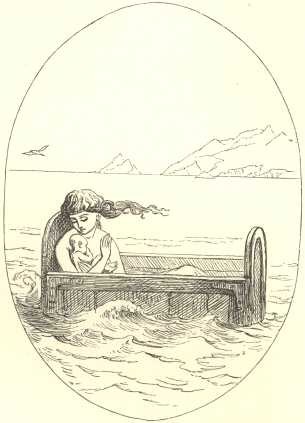
And who were Halcyone and Ceyx? You shall hear while thechest floats on. Halcyone was a fairy maiden, the daughterof the beach and of the wind. And she loved a sailor-boy,and married him; and none on earth were so happy as they. But at last Ceyx was wrecked; and before he could swim to theshore the billows swallowed him up. And Halcyone saw himdrowning, and leapt into the sea to him; but in vain. Thenthe Immortals took pity on them both, and changed them into twofair sea-birds; and now they build a floating nest every year,and sail up and down happily for ever upon the pleasant seas ofGreece.
So a night passed, and a day, and a long day it was for Danae;and another night and day beside, till Danae was faint withhunger and weeping, and yet no land appeared. And all thewhile the babe slept quietly; and at last poor Danae drooped herhead and fell asleep likewise with her cheek against thebabe’s.
After a while she was awakened suddenly; for the chest wasjarring and grinding, and the air was full of sound. Shelooked up, and over her head were mighty cliffs, all red in thesetting sun, and around her rocks and breakers, and flying flakesof foam. She clasped her hands together, and shrieked aloudfor help. And when she cried, help met her: for now therecame over the rocks a tall and stately man, and looked downwondering upon poor Danae tossing about in the chest among thewaves.
He wore a rough cloak of frieze, and on his head a broad hatto shade his face; in his hand he carried a trident for spearingfish, and over his shoulder was a casting-net; but Danae couldsee that he was no common man by his stature, and his walk, andhis flowing golden hair and beard; and by the two servants whocame behind him, carrying baskets for his fish. But she hadhardly time to look at him, before he had laid aside his tridentand leapt down the rocks, and thrown his casting-net so surelyover Danae and the chest, that he drew it, and her, and the baby,safe upon a ledge of rock.
Then the fisherman took Danae by the hand, and lifted her outof the chest, and said—
‘O beautiful damsel, what strange chance has brought youto this island in so flail a ship? Who are you, andwhence? Surely you are some king’s daughter; and thisboy has somewhat more than mortal.’
And as he spoke he pointed to the babe; for its face shonelike the morning star.
But Danae only held down her head, and sobbed out—
‘Tell me to what land I have come, unhappy that I am;and among what men I have fallen!’
And he said, ‘This isle is called Seriphos, and I am aHellen, and dwell in it. I am the brother of Polydectes theking; and men call me Dictys the netter, because I catch the fishof the shore.’
Then Danae fell down at his feet, and embraced his knees, andcried—
‘Oh, sir, have pity upon a stranger, whom a cruel doomhas driven to your land; and let me live in your house as aservant; but treat me honourably, for I was once a king’sdaughter, and this my boy (as you have truly said) is of nocommon race. I will not be a charge to you, or eat thebread of idleness; for I am more skilful in weaving andembroidery than all the maidens of my land.’
And she was going on; but Dictys stopped her, and raised herup, and said—
‘My daughter, I am old, and my hairs are growing gray;while I have no children to make my home cheerful. Comewith me then, and you shall be a daughter to me and to my wife,and this babe shall be our grandchild. For I fear the Gods,and show hospitality to all strangers; knowing that good deeds,like evil ones, always return to those who do them.’
So Danae was comforted, and went home with Dictys the goodfisherman, and was a daughter to him and to his wife, tillfifteen years were past.
p.8PART II
HOW PERSEUS VOWED A RASH VOW
Fifteen years were past and gone, and the babe was now grownto be a tall lad and a sailor, and went many voyages aftermerchandise to the islands round. His mother called himPerseus; but all the people in Seriphos said that he was not theson of mortal man, and called him the son of Zeus, the king ofthe Immortals. For though he was but fifteen, he was tallerby a head than any man in the island; and he was the most skilfulof all in running and wrestling and boxing, and in throwing thequoit and the javelin, and in rowing with the oar, and in playingon the harp, and in all which befits a man. And he wasbrave and truthful, gentle and courteous, for good old Dictys hadtrained him well; and well it was for Perseus that he had doneso. For now Danae and her son fell into great danger, andPerseus had need of all his wit to defend his mother andhimself.
I said that Dictys’ brother was Polydectes, king of theisland. He was not a righteous man, like Dictys; butgreedy, and cunning, and cruel. And when he saw fair Danae,he wanted to marry her. But she would not; for she did notlove him, and cared for no one but her boy, and her boy’sfather, whom she never hoped to see again. At lastPolydectes became furious; and while Perseus was away at sea hetook poor Danae away from Dictys, saying, ‘If you will notbe my wife, you shall be my slave.’ So Danae was madea slave, and had to fetch water from the well, and grind in themill, and perhaps was beaten, and wore a heavy chain, because shewould not marry that cruel king. But Perseus was far awayover the seas in the isle of Samos, little thinking how hismother was languishing in grief.
Now one day at Samos, while the ship was lading, Perseuswandered into a pleasant wood to get out of the sun, and sat downon the turf and fell asleep. And as he slept a strangedream came to him—the strangest dream which he had ever hadin his life.
There came a lady to him through the wood, taller than he, orany mortal man; but beautiful exceedingly, with great gray eyes,clear and piercing, but strangely soft and mild. On herhead was a helmet, and in her hand a spear. And over hershoulder, above her long blue robes, hung a goat-skin, which boreup a mighty shield of brass, polished like a mirror. Shestood and looked at him with her clear gray eyes; and Perseus sawthat her eye-lids never moved, nor her eyeballs, but lookedstraight through and through him, and into his very heart, as ifshe could see all the secrets of his soul, and knew all that hehad ever thought or longed for since the day that he wasborn. And Perseus dropped his eyes, trembling and blushing,as the wonderful lady spoke.
‘Perseus, you must do an errand for me.’
‘Who are you, lady? And how do you know myname?’
‘I am Pallas Athené; and I know the thoughts ofall men’s hearts, and discern their manhood or theirbaseness. And from the souls of clay I turn away, and theyare blest, but not by me. They fatten at ease, like sheepin the pasture, and eat what they did not sow, like oxen in thestall. They grow and spread, like the gourd along theground; but, like the gourd, they give no shade to the traveller,and when they are ripe death gathers them, and they go downunloved into hell, and their name vanishes out of the land.
‘But to the souls of fire I give more fire, and to thosewho are manful I give a might more than man’s. Theseare the heroes, the sons of the Immortals, who are blest, but notlike the souls of clay. For I drive them forth by strangepaths, Perseus, that they may fight the Titans and the monsters,the enemies of Gods and men. Through doubt and need, dangerand battle, I drive them; and some of them are slain in theflower of youth, no man knows when or where; and some of them winnoble names, and a fair and green old age; but what will be theirlatter end I know not, and none, save Zeus, the father of Godsand men. Tell me now, Perseus, which of these two sorts ofmen seem to you more blest?’
Then Perseus answered boldly: ‘Better to die in theflower of youth, on the chance of winning a noble name, than tolive at ease like the sheep, and die unloved andunrenowned.’
Then that strange lady laughed, and held up her brazen shield,and cried: ‘See here, Perseus; dare you face such a monsteras this, and slay it, that I may place its head upon thisshield?’
And in the mirror of the shield there appeared a face, and asPerseus looked on it his blood ran cold. It was the face ofa beautiful woman; but her cheeks were pale as death, and herbrows were knit with everlasting pain, and her lips were thin andbitter like a snake’s; and instead of hair, vipers wreathedabout her temples, and shot out their forked tongues; while roundher head were folded wings like an eagle’s, and upon herbosom claws of brass.
And Perseus looked awhile, and then said: ‘If there isanything so fierce and foul on earth, it were a noble deed tokill it. Where can I find the monster?’
Then the strange lady smiled again, and said: ‘Not yet;you are too young, and too unskilled; for this is Medusa theGorgon, the mother of a monstrous brood. Return to yourhome, and do the work which waits there for you. You mustplay the man in that before I can think you worthy to go insearch of the Gorgon.’
Then Perseus would have spoken, but the strange lady vanished,and he awoke; and behold, it was a dream. But day and nightPerseus saw before him the face of that dreadful woman, with thevipers writhing round her head.
So he returned home; and when he came to Seriphos, the firstthing which he heard was that his mother was a slave in the houseof Polydectes.
Grinding his teeth with rage, he went out, and away to theking’s palace, and through the men’s rooms, and thewomen’s rooms, and so through all the house (for no onedared stop him, so terrible and fair was he), till he found hismother sitting on the floor, turning the stone hand-mill, andweeping as she turned it. And he lifted her up, and kissedher, and bade her follow him forth. But before they couldpass out of the room Polydectes came in, raging. And whenPerseus saw him, he flew upon him as the mastiff flies on theboar. ‘Villain and tyrant!’ he cried; ‘isthis your respect for the Gods, and thy mercy to strangers andwidows? You shall die!’ And because he had nosword he caught up the stone hand-mill, and lifted it to dash outPolydectes’ brains.
But his mother clung to him, shrieking, ‘Oh, my son, weare strangers and helpless in the land; and if you kill the king,all the people will fall on us, and we shall both die.’
Good Dictys, too, who had come in, entreated him. ‘Remember that he is my brother. Remember how I havebrought you up, and trained you as my own son, and spare him formy sake.’
Then Perseus lowered his hand; and Polydectes, who had beentrembling all this while like a coward, because he knew that hewas in the wrong, let Perseus and his mother pass.
Perseus took his mother to the temple of Athené, andthere the priestess made her one of the temple-sweepers; forthere they knew she would be safe, and not even Polydectes woulddare to drag her away from the altar. And there Perseus,and the good Dictys, and his wife, came to visit her every day;while Polydectes, not being able to get what he wanted by force,cast about in his wicked heart how he might get it bycunning.
Now he was sure that he could never get back Danae as long asPerseus was in the island; so he made a plot to rid himself ofhim. And first he pretended to have forgiven Perseus, andto have forgotten Danae; so that, for a while, all went assmoothly as ever.
Next he proclaimed a great feast, and invited to it all thechiefs, and landowners, and the young men of the island, andamong them Perseus, that they might all do him homage as theirking, and eat of his banquet in his hall.
On the appointed day they all came; and as the custom wasthen, each guest brought his present with him to the king: one ahorse, another a shawl, or a ring, or a sword; and those who hadnothing better brought a basket of grapes, or of game; butPerseus brought nothing, for he had nothing to bring, being but apoor sailor-lad.
He was ashamed, however, to go into the king’s presencewithout his gift; and he was too proud to ask Dictys to lend himone. So he stood at the door sorrowfully, watching the richmen go in; and his face grew very red as they pointed at him, andsmiled, and whispered, ‘What has that foundling togive?’
Now this was what Polydectes wanted; and as soon as he heardthat Perseus stood without, he bade them bring him in, and askedhim scornfully before them all, ‘Am I not your king,Perseus, and have I not invited you to my feast? Where isyour present, then?’
Perseus blushed and stammered, while all the proud men roundlaughed, and some of them began jeering him openly. ‘This fellow was thrown ashore here like a piece of weed ordrift-wood, and yet he is too proud to bring a gift to theking.’
‘And though he does not know who his father is, he isvain enough to let the old women call him the son ofZeus.’
And so forth, till poor Perseus grew mad with shame, andhardly knowing what he said, cried out,—‘A present!who are you who talk of presents? See if I do not bring anobler one than all of yours together!’
So he said boasting; and yet he felt in his heart that he wasbraver than all those scoffers, and more able to do some gloriousdeed.
‘Hear him! Hear the boaster! What is it tobe?’ cried they all, laughing louder than ever.
Then his dream at Samos came into his mind, and he criedaloud, ‘The head of the Gorgon.’
He was half afraid after he had said the words for all laughedlouder than ever, and Polydectes loudest of all.
‘You have promised to bring me the Gorgon’shead? Then never appear again in this island withoutit. Go!’
Perseus ground his teeth with rage, for he saw that he hadfallen into a trap; but his promise lay upon him, and he went outwithout a word.
Down to the cliffs he went, and looked across the broad bluesea; and he wondered if his dream were true, and prayed in thebitterness of his soul.
‘Pallas Athené, was my dream true? and shall Islay the Gorgon? If thou didst really show me her face, letme not come to shame as a liar and boastful. Rashly andangrily I promised; but cunningly and patiently will Iperform.’
But there was no answer, nor sign; neither thunder nor anyappearance; not even a cloud in the sky.
And three times Perseus called weeping, ‘Rashly andangrily I promised; but cunningly and patiently will Iperform.’
Then he saw afar off above the sea a small white cloud, asbright as silver. And it came on, nearer and nearer, tillits brightness dazzled his eyes.
Perseus wondered at that strange cloud, for there was no othercloud all round the sky; and he trembled as it touched the cliffbelow. And as it touched, it broke, and parted, and withinit appeared Pallas Athené, as he had seen her at Samos inhis dream, and beside her a young man more light-limbed than thestag, whose eyes were like sparks of fire. By his side wasa scimitar of diamond, all of one clear precious stone, and onhis feet were golden sandals, from the heels of which grew livingwings.
They looked upon Perseus keenly, and yet they never movedtheir eyes; and they came up the cliffs towards him more swiftlythan the sea-gull, and yet they never moved their feet, nor didthe breeze stir the robes about their limbs; only the wings ofthe youth’s sandals quivered, like a hawk’s when hehangs above the cliff. And Perseus fell down andworshipped, for he knew that they were more than man.
But Athené stood before him and spoke gently, and bidhim have no fear. Then—
‘Perseus,’ she said, ‘he who overcomes inone trial merits thereby a sharper trial still. You havebraved Polydectes, and done manfully. Dare you brave Medusathe Gorgon?’
And Perseus said, ‘Try me; for since you spoke to me inSamos a new soul has come into my breast, and I should be ashamednot to dare anything which I can do. Show me, then, how Ican do this!’
‘Perseus,’ said Athené, ‘think wellbefore you attempt; for this deed requires a seven years’journey, in which you cannot repent or turn back nor escape; butif your heart fails you, you must die in the Unshapen Land, whereno man will ever find your bones.’
‘Better so than live here, useless and despised,’said Perseus. ‘Tell me, then, oh tell me, fair andwise Goddess, of your great kindness and condescension, how I cando but this one thing, and then, if need be, die!’
Then Athené smiled and said—
‘Be patient, and listen; for if you forget my words, youwill indeed die. You must go northward to the country ofthe Hyperboreans, who live beyond the pole, at the sources of thecold north wind, till you find the three Gray Sisters, who havebut one eye and one tooth between them. You must ask themthe way to the Nymphs, the daughters of the Evening Star, whodance about the golden tree, in the Atlantic island of thewest. They will tell you the way to the Gorgon, that youmay slay her, my enemy, the mother of monstrous beasts. Once she was a maiden as beautiful as morn, till in her pride shesinned a sin at which the sun hid his face; and from that day herhair was turned to vipers, and her hands to eagle’s claws;and her heart was filled with shame and rage, and her lips withbitter venom; and her eyes became so terrible that whosoeverlooks on them is turned to stone; and her children are the wingedhorse and the giant of the golden sword; and her grandchildrenare Echidna the witch-adder, and Geryon the three-headed tyrant,who feeds his herds beside the herds of hell. So she becamethe sister of the Gorgons, Stheino and Euryte the abhorred, thedaughters of the Queen of the Sea. Touch them not, for theyare immortal; but bring me only Medusa’s head.’
‘And I will bring it!’ said Perseus; ‘buthow am I to escape her eyes? Will she not freeze me toointo stone?’
‘You shall take this polished shield,’ saidAthené, ‘and when you come near her look not at herherself, but at her image in the brass; so you may strike hersafely. And when you have struck off her head, wrap it,with your face turned away, in the folds of the goat-skin onwhich the shield hangs, the hide of Amaltheié, the nurseof the Ægis-holder. So you will bring it safely backto me, and win to yourself renown, and a place among the heroeswho feast with the Immortals upon the peak where no windsblow.’
Then Perseus said, ‘I will go, though I die ingoing. But how shall I cross the seas without a ship? And who will show me my way? And when I find her, how shallI slay her, if her scales be iron and brass?’
Then the young man spoke: ‘These sandals of mine willbear you across the seas, and over hill and dale like a bird, asthey bear me all day long; for I am Hermes, the far-famedArgus-slayer, the messenger of the Immortals who dwell onOlympus.’
Then Perseus fell down and worshipped, while the young manspoke again:
‘The sandals themselves will guide you on the road, forthey are divine and cannot stray; and this sword itself, theArgus-slayer, will kill her, for it is divine, and needs nosecond stroke. Arise, and gird them on, and goforth.’
So Perseus arose, and girded on the sandals and the sword.
And Athené cried, ‘Now leap from the cliff and begone.’
But Perseus lingered.
‘May I not bid farewell to my mother and toDictys? And may I not offer burnt-offerings to you, and toHermes the far-famed Argus-slayer, and to Father Zeusabove?’
‘You shall not bid farewell to your mother, lest yourheart relent at her weeping. I will comfort her and Dictysuntil you return in peace. Nor shall you offerburnt-offerings to the Olympians; for your offering shall beMedusa’s head. Leap, and trust in the armour of theImmortals.’
Then Perseus looked down the cliff and shuddered; but he wasashamed to show his dread. Then he thought of Medusa andthe renown before him, and he leaped into the empty air.
And behold, instead of falling he floated, and stood, and ranalong the sky. He looked back, but Athené hadvanished, and Hermes; and the sandals led him on northward ever,like a crane who follows the spring toward the Ister fens.
p.23PART III
HOW PERSEUS SLEW THE GORGON
So Perseus started on his journey, going dry-shod over landand sea; and his heart was high and joyful, for the wingedsandals bore him each day a seven days’ journey.
And he went by Cythnus, and by Ceos, and the pleasant Cycladesto Attica; and past Athens and Thebes, and the Copaic lake, andup the vale of Cephissus, and past the peaks of Œta andPindus, and over the rich Thessalian plains, till the sunny hillsof Greece were behind him, and before him were the wilds of thenorth. Then he passed the Thracian mountains, and many abarbarous tribe, Pæons and Dardans and Triballi, till hecame to the Ister stream, and the dreary Scythian plains. And he walked across the Ister dry-shod, and away through themoors and fens, day and night toward the bleak north-west,turning neither to the right hand nor the left, till he came tothe Unshapen Land, and the place which has no name.
And seven days he walked through it, on a path which few cantell; for those who have trodden it like least to speak of it,and those who go there again in dreams are glad enough when theyawake; till he came to the edge of the everlasting night, wherethe air was full of feathers, and the soil was hard with ice; andthere at last he found the three Gray Sisters, by the shore ofthe freezing sea, nodding upon a white log of drift-wood, beneaththe cold white winter moon; and they chaunted a low songtogether, ‘Why the old times were better than thenew.’
There was no living thing around them, not a fly, not a mossupon the rocks. Neither seal nor sea-gull dare come near,lest the ice should clutch them in its claws. The surgebroke up in foam, but it fell again in flakes of snow; and itfrosted the hair of the three Gray Sisters, and the bones in theice-cliff above their heads. They passed the eye from oneto the other, but for all that they could not see; and theypassed the tooth from one to the other, but for all that theycould not eat; and they sat in the full glare of the moon, butthey were none the warmer for her beams. And Perseus pitiedthe three Gray Sisters; but they did not pity themselves.
So he said, ‘Oh, venerable mothers, wisdom is thedaughter of old age. You therefore should know manythings. Tell me, if you can, the path to theGorgon.’
Then one cried, ‘Who is this who reproaches us with oldage?’ And another, ‘This is the voice of one ofthe children of men.’
And he, ‘I do not reproach, but honour your old age, andI am one of the sons of men and of the heroes. The rulersof Olympus have sent me to you to ask the way to theGorgon.’
Then one, ‘There are new rulers in Olympus, and all newthings are bad.’ And another, ‘We hate yourrulers, and the heroes, and all the children of men. We arethe kindred of the Titans, and the Giants, and the Gorgons, andthe ancient monsters of the deep.’ And another,‘Who is this rash and insolent man who pushes unbidden intoour world?’ And the first, ‘There never wassuch a world as ours, nor will be; if we let him see it, he willspoil it all.’
Then one cried, ‘Give me the eye, that I may seehim;’ and another, ‘Give me the tooth, that I maybite him.’ But Perseus, when he saw that they werefoolish and proud, and did not love the children of men, left offpitying them, and said to himself, ‘Hungry men must needsbe hasty; if I stay making many words here, I shall bestarved.’ Then he stepped close to them, and watchedtill they passed the eye from hand to hand. And as theygroped about between themselves, he held out his own hand gently,till one of them put the eye into it, fancying that it was thehand of her sister. Then he sprang back, and laughed, andcried—
‘Cruel and proud old women, I have your eye; and I willthrow it into the sea, unless you tell me the path to the Gorgon,and swear to me that you tell me right.’
Then they wept, and chattered, and scolded; but in vain. They were forced to tell the truth, though, when they told it,Perseus could hardly make out the road.
‘You must go,’ they said, ‘foolish boy, tothe southward, into the ugly glare of the sun, till you come toAtlas the Giant, who holds the heaven and the earth apart. And you must ask his daughters, the Hesperides, who are young andfoolish like yourself. And now give us back our eye, for wehave forgotten all the rest.’
So Perseus gave them back their eye; but instead of using it,they nodded and fell fast asleep, and were turned into blocks ofice, till the tide came up and washed them all away. Andnow they float up and down like icebergs for ever, weepingwhenever they meet the sunshine, and the fruitful summer and thewarm south wind, which fill young hearts with joy.
But Perseus leaped away to the southward, leaving the snow andthe ice behind: past the isle of the Hyperboreans, and the tinisles, and the long Iberian shore, while the sun rose higher dayby day upon a bright blue summer sea. And the terns and thesea-gulls swept laughing round his head, and called to him tostop and play, and the dolphins gambolled up as he passed, andoffered to carry him on their backs. And all night long thesea-nymphs sang sweetly, and the Tritons blew upon their conchs,as they played round Galatæa their queen, in her car ofpearled shells. Day by day the sun rose higher, and leapedmore swiftly into the sea at night, and more swiftly out of thesea at dawn; while Perseus skimmed over the billows like asea-gull, and his feet were never wetted; and leapt on from waveto wave, and his limbs were never weary, till he saw far away amighty mountain, all rose-red in the setting sun. Its feetwere wrapped in forests, and its head in wreaths of cloud; andPerseus knew that it was Atlas, who holds the heavens and theearth apart.
He came to the mountain, and leapt on shore, and wanderedupward, among pleasant valleys and waterfalls, and tall trees andstrange ferns and flowers; but there was no smoke rising from anyglen, nor house, nor sign of man.
At last he heard sweet voices singing; and he guessed that hewas come to the garden of the Nymphs, the daughters of theEvening Star.
They sang like nightingales among the thickets, and Perseusstopped to hear their song; but the words which they spoke hecould not understand; no, nor no man after him for many a hundredyears. So he stepped forward and saw them dancing, hand inhand around the charmed tree, which bent under its golden fruit;and round the tree-foot was coiled the dragon, old Ladon thesleepless snake, who lies there for ever, listening to the songof the maidens, blinking and watching with dry bright eyes.
Then Perseus stopped, not because he feared the dragon, butbecause he was bashful before those fair maids; but when they sawhim, they too stopped, and called to him with tremblingvoices—
‘Who are you? Are you Heracles the mighty, whowill come to rob our garden, and carry off our goldenfruit?’ And he answered—
‘I am not Heracles the mighty, and I want none of yourgolden fruit. Tell me, fair Nymphs, the way which leads tothe Gorgon, that I may go on my way and slay her.’
‘Not yet, not yet, fair boy; come dance with us aroundthe tree in the garden which knows no winter, the home of thesouth wind and the sun. Come hither and play with usawhile; we have danced alone here for a thousand years, and ourhearts are weary with longing for a playfellow. So come,come, come!’
‘I cannot dance with you, fair maidens; for I must dothe errand of the Immortals. So tell me the way to theGorgon, lest I wander and perish in the waves.’
Then they sighed and wept; and answered—‘TheGorgon! she will freeze you into stone.’
‘It is better to die like a hero than to live like an oxin a stall. The Immortals have lent me weapons, and theywill give me wit to use them.’
Then they sighed again and answered, ‘Fair boy, if youare bent on your own ruin, be it so. We know not the way tothe Gorgon; but we will ask the giant Atlas, above upon themountain peak, the brother of our father, the silver EveningStar. He sits aloft and sees across the ocean, and far awayinto the Unshapen Land.’
So they went up the mountain to Atlas their uncle, and Perseuswent up with them. And they found the giant kneeling, as heheld the heavens and the earth apart.
They asked him, and he answered mildly, pointing to thesea-board with his mighty hand, ‘I can see the Gorgonslying on an island far away, but this youth can never come nearthem, unless he has the hat of darkness, which whosoever wearscannot be seen.’
Then cried Perseus, ‘Where is that hat, that I may findit?’
But the giant smiled. ‘No living mortal can findthat hat, for it lies in the depths of Hades, in the regions ofthe dead. But my nieces are immortal, and they shall fetchit for you, if you will promise me one thing and keep yourfaith.’
Then Perseus promised; and the giant said, ‘When youcome back with the head of Medusa, you shall show me thebeautiful horror, that I may lose my feeling and my breathing,and become a stone for ever; for it is weary labour for me tohold the heavens and the earth apart.’
Then Perseus promised, and the eldest of the Nymphs went down,and into a dark cavern among the cliffs, out of which came smokeand thunder, for it was one of the mouths of Hell.
And Perseus and the Nymphs sat down seven days, and waitedtrembling, till the Nymph came up again; and her face was pale,and her eyes dazzled with the light, for she had been long in thedreary darkness; but in her hand was the magic hat.
Then all the Nymphs kissed Perseus, and wept over him a longwhile; but he was only impatient to be gone. And at lastthey put the hat upon his head, and he vanished out of theirsight.
But Perseus went on boldly, past many an ugly sight, far awayinto the heart of the Unshapen Land, beyond the streams of Ocean,to the isles where no ship cruises, where is neither night norday, where nothing is in its right place, and nothing has a name;till he heard the rustle of the Gorgons’ wings and saw theglitter of their brazen talons; and then he knew that it was timeto halt, lest Medusa should freeze him into stone.
He thought awhile with himself, and rememberedAthené’s words. He rose aloft into the air,and held the mirror of the shield above his head, and looked upinto it that he might see all that was below him.
And he saw the three Gorgons sleeping as huge aselephants. He knew that they could not see him, because thehat of darkness hid him; and yet he trembled as he sank down nearthem, so terrible were those brazen claws.
Two of the Gorgons were foul as swine, and lay sleepingheavily, as swine sleep, with their mighty wings outspread; butMedusa tossed to and fro restlessly, and as she tossed Perseuspitied her, she looked so fair and sad. Her plumage waslike the rainbow, and her face was like the face of a nymph, onlyher eyebrows were knit, and her lips clenched, with everlastingcare and pain; and her long neck gleamed so white in the mirrorthat Perseus had not the heart to strike, and said, ‘Ah,that it had been either of her sisters!’
But as he looked, from among her tresses the vipers’heads awoke, and peeped up with their bright dry eyes, and showedtheir fangs, and hissed; and Medusa, as she tossed, threw backher wings and showed her brazen claws; and Perseus saw that, forall her beauty, she was as foul and venomous as the rest.
Then he came down and stepped to her boldly, and lookedsteadfastly on his mirror, and struck with Herpé stoutlyonce; and he did not need to strike again.
Then he wrapped the head in the goat-skin, turning away hiseyes, and sprang into the air aloft, faster than he ever sprangbefore.
For Medusa’s wings and talons rattled as she sank deadupon the rocks; and her two foul sisters woke, and saw her lyingdead.
Into the air they sprang yelling and looked for him who haddone the deed. Thrice they swung round and round, likehawks who beat for a partridge; and thrice they snuffed round andround, like hounds who draw upon a deer. At last theystruck upon the scent of the blood, and they checked for a momentto make sure; and then on they rushed with a fearful howl, whilethe wind rattled hoarse in their wings.
On they rushed, sweeping and flapping, like eagles after ahare; and Perseus’ blood ran cold, for all his courage, ashe saw them come howling on his track; and he cried, ‘Bearme well now, brave sandals, for the hounds of Death are at myheels!’
And well the brave sandals bore him, aloft through cloud andsunshine, across the shoreless sea; and fast followed the houndsof Death, as the roar of their wings came down the wind. But the roar came down fainter and fainter, and the howl of theirvoices died away; for the sandals were too swift, even forGorgons, and by nightfall they were far behind, two black specksin the southern sky, till the sun sank and he saw them nomore.
Then he came again to Atlas, and the garden of the Nymphs; andwhen the giant heard him coming he groaned, and said,‘Fulfil thy promise to me.’ Then Perseus heldup to him the Gorgon’s head, and he had rest from all histoil; for he became a crag of stone, which sleeps for ever farabove the clouds.
Then he thanked the Nymphs, and asked them, ‘By whatroad shall I go homeward again, for I wandered far round incoming hither?’
And they wept and cried, ‘Go home no more, but stay andplay with us, the lonely maidens, who dwell for ever far awayfrom Gods and men.’
But he refused, and they told him his road, and said,‘Take with you this magic fruit, which, if you eat once,you will not hunger for seven days. For you must goeastward and eastward ever, over the doleful Lybian shore, whichPoseidon gave to Father Zeus, when he burst open the Bosphorusand the Hellespont, and drowned the fair Lectonian land. And Zeus took that land in exchange, a fair bargain, much badground for a little good, and to this day it lies waste anddesert with shingle, and rock, and sand.’
Then they kissed Perseus, and wept over him, and he leapt downthe mountain, and went on, lessening and lessening like asea-gull, away and out to sea.
p.36PART IV
HOW PERSEUS CAME TO THE ÆTHIOPS
So Perseus flitted onward to the north-east, over many aleague of sea, till he came to the rolling sand-hills and thedreary Lybian shore.
And he flitted on across the desert: over rock-ledges, andbanks of shingle, and level wastes of sand, and shell-driftsbleaching in the sunshine, and the skeletons of greatsea-monsters, and dead bones of ancient giants, strewn up anddown upon the old sea-floor. And as he went the blood-dropsfell to the earth from the Gorgon’s head, and becamepoisonous asps and adders, which breed in the desert to thisday.
Over the sands he went,—he never knew how far or howlong, feeding on the fruit which the Nymphs had given him, tillhe saw the hills of the Psylli, and the Dwarfs who fought withcranes. Their spears were of reeds and rushes, and theirhouses of the egg-shells of the cranes; and Perseus laughed, andwent his way to the north-east, hoping all day long to see theblue Mediterranean sparkling, that he might fly across it to hishome.
But now came down a mighty wind, and swept him back southwardtoward the desert. All day long he strove against it; buteven the winged sandals could not prevail. So he was forcedto float down the wind all night; and when the morning dawnedthere was nothing to be seen, save the same old hateful waste ofsand.
And out of the north the sandstorms rushed upon him, blood-redpillars and wreaths, blotting out the noonday sun; and Perseusfled before them, lest he should be choked by the burningdust. At last the gale fell calm, and he tried to gonorthward again; but again came down the sandstorms, and swepthim back into the waste, and then all was calm and cloudless asbefore. Seven days he strove against the storms, and sevendays he was driven back, till he was spent with thirst andhunger, and his tongue clove to the roof of his mouth. Hereand there he fancied that he saw a fair lake, and the sunbeamsshining on the water; but when he came to it it vanished at hisfeet, and there was nought but burning sand. And if he hadnot been of the race of the Immortals, he would have perished inthe waste; but his life was strong within him, because it wasmore than man’s.
Then he cried to Athené, and said—
‘Oh, fair and pure, if thou hearest me, wilt thou leaveme here to die of drought? I have brought thee theGorgon’s head at thy bidding, and hitherto thou hastprospered my journey; dost thou desert me at the last? Elsewhy will not these immortal sandals prevail, even against thedesert storms? Shall I never see my mother more, and theblue ripple round Seriphos, and the sunny hills ofHellas?’
So he prayed; and after he had prayed there was a greatsilence.
The heaven was still above his head, and the sand was stillbeneath his feet; and Perseus looked up, but there was nothingbut the blinding sun in the blinding blue; and round him, butthere was nothing but the blinding sand.
And Perseus stood still a while, and waited, and said,‘Surely I am not here without the will of the Immortals,for Athené will not lie. Were not these sandals tolead me in the right road? Then the road in which I havetried to go must be a wrong road.’
Then suddenly his ears were opened, and he heard the sound ofrunning water.
And at that his heart was lifted up, though he scarcely darebelieve his ears; and weary as he was, he hurried forward, thoughhe could scarcely stand upright; and within a bowshot of him wasa glen in the sand, and marble rocks, and date-trees, and a lawnof gay green grass. And through the lawn a streamletsparkled and wandered out beyond the trees, and vanished in thesand.
The water trickled among the rocks, and a pleasant breezerustled in the dry date-branches and Perseus laughed for joy, andleapt down the cliff, and drank of the cool water, and ate of thedates, and slept upon the turf, and leapt up and went forwardagain: but not toward the north this time; for he said,‘Surely Athené hath sent me hither, and will nothave me go homeward yet. What if there be another nobledeed to be done, before I see the sunny hills ofHellas?’
So he went east, and east for ever, by fresh oases andfountains, date-palms, and lawns of grass, till he saw before hima mighty mountain-wall, all rose-red in the setting sun.
Then he towered in the air like an eagle, for his limbs werestrong again; and he flew all night across the mountain till theday began to dawn, and rosy-fingered Eos came blushing up thesky. And then, behold, beneath him was the long greengarden of Egypt and the shining stream of Nile.
And he saw cities walled up to heaven, and temples, andobelisks, and pyramids, and giant Gods of stone. And hecame down amid fields of barley, and flax, and millet, andclambering gourds; and saw the people coming out of the gates ofa great city, and setting to work, each in his place, among thewater-courses, parting the streams among the plants cunninglywith their feet, according to the wisdom of the Egyptians. But when they saw him they all stopped their work, and gatheredround him, and cried—
‘Who art thou, fair youth? and what bearest thou beneaththy goat-skin there? Surely thou art one of the Immortals;for thy skin is white like ivory, and ours is red likeclay. Thy hair is like threads of gold, and ours is blackand curled. Surely thou art one of the Immortals;’and they would have worshipped him then and there; but Perseussaid—
‘I am not one of the Immortals; but I am a hero of theHellens. And I have slain the Gorgon in the wilderness, andbear her head with me. Give me food, therefore, that I maygo forward and finish my work.’
Then they gave him food, and fruit, and wine; but they wouldnot let him go. And when the news came into the city thatthe Gorgon was slain, the priests came out to meet him, and themaidens, with songs and dances, and timbrels and harps; and theywould have brought him to their temple and to their king; butPerseus put on the hat of darkness, and vanished away out oftheir sight.
Therefore the Egyptians looked long for his return, but invain, and worshipped him as a hero, and made a statue of him inChemmis, which stood for many a hundred years; and they said thathe appeared to them at times, with sandals a cubit long; and thatwhenever he appeared the season was fruitful, and the Nile rosehigh that year.
Then Perseus went to the eastward, along the Red Sea shore;and then, because he was afraid to go into the Arabian deserts,he turned northward once more, and this time no storm hinderedhim.
He went past the Isthmus, and Mount Casius, and the vastSerbonian bog, and up the shore of Palestine, where thedark-faced Æthiops dwelt.
He flew on past pleasant hills and valleys, like Argos itself,or Lacedæmon, or the fair Vale of Tempe. But thelowlands were all drowned by floods, and the highlands blasted byfire, and the hills heaved like a babbling cauldron, before thewrath of King Poseidon, the shaker of the earth.
And Perseus feared to go inland, but flew along the shoreabove the sea; and he went on all the day, and the sky was blackwith smoke; and he went on all the night, and the sky was redwith flame.
And at the dawn of day he looked toward the cliffs; and at thewater’s edge, under a black rock, he saw a white imagestand.
‘This,’ thought he, ‘must surely be thestatue of some sea-God; I will go near and see what kind of Godsthese barbarians worship.’
So he came near; but when he came, it was no statue, but amaiden of flesh and blood; for he could see her tresses streamingin the breeze; and as he came closer still, he could see how sheshrank and shivered when the waves sprinkled her with cold saltspray. Her arms were spread above her head, and fastened tothe rock with chains of brass; and her head drooped on her bosom,either with sleep, or weariness, or grief. But now and thenshe looked up and wailed, and called her mother; yet she did notsee Perseus, for the cap of darkness was on his head.
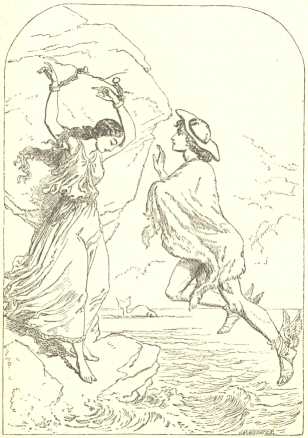
Full of pity and indignation, Perseus drew near and lookedupon the maid. Her cheeks were darker than his were, andher hair was blue-black like a hyacinth; but Perseus thought,‘I have never seen so beautiful a maiden; no, not in allour isles. Surely she is a king’s daughter. Dobarbarians treat their kings’ daughters thus? She istoo fair, at least, to have done any wrong I will speak toher.’
And, lifting the hat from his head, he flashed into hersight. She shrieked with terror, and tried to hide her facewith her hair, for she could not with her hands; but Perseuscried—
‘Do not fear me, fair one; I am a Hellen, and nobarbarian. What cruel men have bound you? But first Iwill set you free.’
And he tore at the fetters, but they were too strong for him;while the maiden cried—
‘Touch me not; I am accursed, devoted as a victim to thesea-Gods. They will slay you, if you dare to set mefree.’
‘Let them try,’ said Perseus; and drawing,Herpé from his thigh, he cut through the brass as if ithad been flax.
‘Now,’ he said, ‘you belong to me, and notto these sea-Gods, whosoever they may be!’ But sheonly called the more on her mother.
‘Why call on your mother? She can be no mother tohave left you here. If a bird is dropped out of the nest,it belongs to the man who picks it up. If a jewel is castby the wayside, it is his who dare win it and wear it, as I willwin you and will wear you. I know now why PallasAthené sent me hither. She sent me to gain a prizeworth all my toil and more.’
And he clasped her in his arms, and cried, ‘Where arethese sea-Gods, cruel and unjust, who doom fair maids todeath? I carry the weapons of Immortals. Let themmeasure their strength against mine! But tell me, maiden,who you are, and what dark fate brought you here.’
And she answered, weeping—
‘I am the daughter of Cepheus, King of Iopa, and mymother is Cassiopoeia of the beautiful tresses, and they calledme Andromeda, as long as life was mine. And I stand boundhere, hapless that I am, for the sea-monster’s food, toatone for my mother’s sin. For she boasted of me oncethat I was fairer than Atergatis, Queen of the Fishes; so she inher wrath sent the sea-floods, and her brother the Fire King sentthe earthquakes, and wasted all the land, and after the floods amonster bred of the slime, who devours all living things. And now he must devour me, guiltless though I am—me whonever harmed a living thing, nor saw a fish upon the shore but Igave it life, and threw it back into the sea; for in our land weeat no fish, for fear of Atergatis their queen. Yet thepriests say that nothing but my blood can atone for a sin which Inever committed.’
But Perseus laughed, and said, ‘A sea-monster? Ihave fought with worse than him: I would have faced Immortals foryour sake; how much more a beast of the sea?’
Then Andromeda looked up at him, and new hope was kindled inher breast, so proud and fair did he stand, with one hand roundher, and in the other the glittering sword. But she onlysighed, and wept the more, and cried—
‘Why will you die, young as you are? Is there notdeath and sorrow enough in the world already? It is noblefor me to die, that I may save the lives of a whole people; butyou, better than them all, why should I slay you too? Goyou your way; I must go mine.’
But Perseus cried, ‘Not so; for the Lords of Olympus,whom I serve, are the friends of the heroes, and help them on tonoble deeds. Led by them, I slew the Gorgon, the beautifulhorror; and not without them do I come hither, to slay thismonster with that same Gorgon’s head. Yet hide youreyes when I leave you, lest the sight of it freeze you too tostone.’
But the maiden answered nothing, for she could not believe hiswords. And then, suddenly looking up, she pointed to thesea, and shrieked—
‘There he comes, with the sunrise, as theypromised. I must die now. How shall I endureit? Oh, go! Is it not dreadful enough to be tornpiecemeal, without having you to look on?’ And shetried to thrust him away.
But he said, ‘I go; yet promise me one thing ere I go:that if I slay this beast you will be my wife, and come back withme to my kingdom in fruitful Argos, for I am a king’sheir. Promise me, and seal it with a kiss.’
Then she lifted up her face, and kissed him; and Perseuslaughed for joy, and flew upward, while Andromeda crouchedtrembling on the rock, waiting for what might befall.
On came the great sea-monster, coasting along like a hugeblack galley, lazily breasting the ripple, and stopping at timesby creek or headland to watch for the laughter of girls at theirbleaching, or cattle pawing on the sand-hills, or boys bathing onthe beach. His great sides were fringed with clusteringshells and sea-weeds, and the water gurgled in and out of hiswide jaws, as he rolled along, dripping and glistening in thebeams of the morning sun.
At last he saw Andromeda, and shot forward to take his prey,while the waves foamed white behind him, and before him the fishfled leaping.
Then down from the height of the air fell Perseus like ashooting star; down to the crests of the waves, while Andromedahid her face as he shouted; and then there was silence for awhile.
At last she looked up trembling, and saw Perseus springingtoward her; and instead of the monster a long black rock, withthe sea rippling quietly round it.
Who then so proud as Perseus, as he leapt back to the rock,and lifted his fair Andromeda in his arms, and flew with her tothe cliff-top, as a falcon carries a dove?
Who so proud as Perseus, and who so joyful as all theÆthiop people? For they had stood watching themonster from the cliffs, wailing for the maiden’sfate. And already a messenger had gone to Cepheus andCassiopoeia, where they sat in sackcloth and ashes on the ground,in the innermost palace chambers, awaiting their daughter’send. And they came, and all the city with them, to see thewonder, with songs and with dances, with cymbals and harps, andreceived their daughter back again, as one alive from thedead.
Then Cepheus said, ‘Hero of the Hellens, stay here withme and be my son-in-law, and I will give you the half of mykingdom.’
‘I will be your son-in-law,’ said Perseus,‘but of your kingdom I will have none, for I long after thepleasant land of Greece, and my mother who waits for me athome.’
Then Cepheus said, ‘You must not take my daughter awayat once, for she is to us like one alive from the dead. Stay with us here a year, and after that you shall return withhonour.’ And Perseus consented; but before he went tothe palace he bade the people bring stones and wood, and builtthree altars, one to Athené, and one to Hermes, and one toFather Zeus, and offered bullocks and rams.
And some said, ‘This is a pious man;’ yet thepriests said, ‘The Sea Queen will be yet more fierceagainst us, because her monster is slain.’ But theywere afraid to speak aloud, for they feared the Gorgon’shead. So they went up to the palace; and when they came in,there stood in the hall Phineus, the brother of Cepheus, chafinglike a bear robbed of her whelps, and with him his sons, and hisservants, and many an armed man; and he cried toCepheus—
‘You shall not marry your daughter to this stranger, ofwhom no one knows even the name. Was not Andromedabetrothed to my son? And now she is safe again, has he nota right to claim her?’
But Perseus laughed, and answered, ‘If your son is inwant of a bride, let him save a maiden for himself. As yethe seems but a helpless bride-groom. He left this one todie, and dead she is to him. I saved her alive, and aliveshe is to me, but to no one else. Ungrateful man! have Inot saved your land, and the lives of your sons and daughters,and will you requite me thus? Go, or it will be worse foryou.’ But all the men-at-arms drew their swords, andrushed on him like wild beasts.
Then he unveiled the Gorgon’s head, and said,‘This has delivered my bride from one wild beast: it shalldeliver her from many.’ And as he spoke Phineus andall his men-at-arms stopped short, and stiffened each man as hestood; and before Perseus had drawn the goat-skin over the faceagain, they were all turned into stone.
Then Perseus bade the people bring levers and roll them out;and what was done with them after that I cannot tell.
So they made a great wedding-feast, which lasted seven wholedays, and who so happy as Perseus and Andromeda?
But on the eighth night Perseus dreamed a dream; and he sawstanding beside him Pallas Athené, as he had seen her inSeriphos, seven long years before; and she stood and called himby name, and said—
‘Perseus, you have played the man, and see, you haveyour reward. Know now that the Gods are just, and help himwho helps himself. Now give me here Herpé the sword,and the sandals, and the hat of darkness, that I may give themback to their owners; but the Gorgon’s head you shall keepa while, for you will need it in your land of Greece. Thenyou shall lay it up in my temple at Seriphos, that I may wear iton my shield for ever, a terror to the Titans and the monsters,and the foes of Gods and men. And as for this land, I haveappeased the sea and the fire, and there shall be no more floodsnor earthquakes. But let the people build altars to FatherZeus, and to me, and worship the Immortals, the Lords of heavenand earth.’
And Perseus rose to give her the sword, and the cap, and thesandals; but he woke, and his dream vanished away. And yetit was not altogether a dream; for the goat-skin with the headwas in its place; but the sword, and the cap, and the sandalswere gone, and Perseus never saw them more.
Then a great awe fell on Perseus; and he went out in themorning to the people, and told his dream, and bade them buildaltars to Zeus, the Father of Gods and men, and to Athené,who gives wisdom to heroes; and fear no more the earthquakes andthe floods, but sow and build in peace. And they did so fora while, and prospered; but after Perseus was gone they forgotZeus and Athené, and worshipped again Atergatis the queen,and the undying fish of the sacred lake, where Deucalion’sdeluge was swallowed up, and they burnt their children before theFire King, till Zeus was angry with that foolish people, andbrought a strange nation against them out of Egypt, who foughtagainst them and wasted them utterly, and dwelt in their citiesfor many a hundred years.
p.53PART V
HOW PERSEUS CAME HOME AGAIN
And when a year was ended Perseus hired Phoenicians from Tyre,and cut down cedars, and built himself a noble galley; andpainted its cheeks with vermilion, and pitched its sides withpitch; and in it he put Andromeda, and all her dowry of jewels,and rich shawls, and spices from the East; and great was theweeping when they rowed away. But the remembrance of hisbrave deed was left behind; and Andromeda’s rock was shownat Iopa in Palestine till more than a thousand years werepast.
So Perseus and the Phoenicians rowed to the westward, acrossthe sea of Crete, till they came to the blue Ægean and thepleasant Isles of Hellas, and Seriphos, his ancient home.
Then he left his galley on the beach, and went up as of old;and he embraced his mother, and Dictys his good foster-father,and they wept over each other a long while, for it was sevenyears and more since they had met.
Then Perseus went out, and up to the hall of Polydectes; andunderneath the goat-skin he bore the Gorgon’s head.
And when he came into the hall, Polydectes sat at thetable-head, and all his nobles and landowners on either side,each according to his rank, feasting on the fish and thegoat’s flesh, and drinking the blood-red wine. Theharpers harped, and the revellers shouted, and the wine-cups rangmerrily as they passed from hand to hand, and great was the noisein the hall of Polydectes.
Then Perseus stood upon the threshold, and called to the kingby name. But none of the guests knew Perseus, for he waschanged by his long journey. He had gone out a boy, and hewas come home a hero; his eye shone like an eagle’s, andhis beard was like a lion’s beard, and he stood up like awild bull in his pride.
But Polydectes the wicked knew him, and hardened his heartstill more; and scornfully he called—
‘Ah, foundling! have you found it more easy to promisethan to fulfil?’
‘Those whom the Gods help fulfil their promises; andthose who despise them, reap as they have sown. Behold theGorgon’s head!’
Then Perseus drew back the goat-skin, and held aloft theGorgon’s head.
Pale grew Polydectes and his guests as they looked upon thatdreadful face. They tried to rise up from their seats: butfrom their seats they never rose, but stiffened, each man wherehe sat, into a ring of cold gray stones.
Then Perseus turned and left them, and went down to his galleyin the bay; and he gave the kingdom to good Dictys, and sailedaway with his mother and his bride.
And Polydectes and his guests sat still, with the wine-cupsbefore them on the board, till the rafters crumbled down abovetheir heads, and the walls behind their backs, and the tablecrumbled down between them, and the grass sprung up about theirfeet: but Polydectes and his guests sit on the hillside, a ringof gray stones until this day.
But Perseus rowed westward toward Argos, and landed, and wentup to the town. And when he came, he found that Acrisiushis grandfather had fled. For Proetus his wicked brotherhad made war against him afresh; and had come across the riverfrom Tiryns, and conquered Argos, and Acrisius had fled toLarissa, in the country of the wild Pelasgi.
Then Perseus called the Argives together, and told them who hewas, and all the noble deeds which he had done. And all thenobles and the yeomen made him king, for they saw that he had aroyal heart; and they fought with him against Argos, and took it,and killed Proetus, and made the Cyclopes serve them, and buildthem walls round Argos, like the walls which they had built atTiryns; and there were great rejoicings in the vale of Argos,because they had got a king from Father Zeus.
But Perseus’ heart yearned after his grandfather, and hesaid, ‘Surely he is my flesh and blood, and he will love menow that I am come home with honour: I will go and find him, andbring him home, and we will reign together in peace.’
So Perseus sailed away with his Phoenicians, round Hydrea andSunium, past Marathon and the Attic shore, and through Euripus,and up the long Euboean sea, till he came to the town of Larissa,where the wild Pelasgi dwelt.
And when he came there, all the people were in the fields, andthere was feasting, and all kinds of games; for Teutamenes theirking wished to honour Acrisius, because he was the king of amighty land.
So Perseus did not tell his name, but went up to the gamesunknown; for he said, ‘If I carry away the prize in thegames, my grandfather’s heart will be softened towardme.’
So he threw off his helmet, and his cuirass, and all hisclothes, and stood among the youths of Larissa, while allwondered at him, and said, ‘Who is this young stranger, whostands like a wild bull in his pride? Surely he is one ofthe heroes, the sons of the Immortals, from Olympus.’
And when the games began, they wondered yet more; for Perseuswas the best man of all at running, and leaping, and wrestlingand throwing the javelin; and he won four crowns, and took them,and then he said to himself, ‘There is a fifth crown yet tobe won: I will win that, and lay them all upon the knees of mygrandfather.’
And as he spoke, he saw where Acrisius sat, by the side ofTeutamenes the king, with his white beard flowing down upon hisknees, and his royal staff in his hand; and Perseus wept when helooked at him, for his heart yearned after his kin; and he said,‘Surely he is a kingly old man, yet he need not be ashamedof his grandson.’
Then he took the quoits, and hurled them, five fathoms beyondall the rest; and the people shouted, ‘Further yet, bravestranger! There has never been such a hurler in thisland.’
Then Perseus put out all his strength, and hurled. But agust of wind came from the sea, and carried the quoit aside, andfar beyond all the rest; and it fell on the foot of Acrisius, andhe swooned away with the pain.
Perseus shrieked, and ran up to him; but when they lifted theold man up he was dead, for his life was slow and feeble.
Then Perseus rent his clothes, and cast dust upon his head,and wept a long while for his grandfather. At last he rose,and called to all the people aloud, and said—
‘The Gods are true, and what they have ordained mustbe. I am Perseus, the grandson of this dead man, thefar-famed slayer of the Gorgon.’
Then he told them how the prophecy had declared that he shouldkill his grandfather, and all the story of his life.
So they made a great mourning for Acrisius, and burnt him on aright rich pile; and Perseus went to the temple, and was purifiedfrom the guilt of the death, because he had done itunknowingly.
Then he went home to Argos, and reigned there well with fairAndromeda; and they had four sons and three daughters, and diedin a good old age.
And when they died, the ancients say, Athené took themup into the sky, with Cepheus and Cassiopoeia. And there onstarlight nights you may see them shining still; Cepheus with hiskingly crown, and Cassiopoeia in her ivory chair, plaiting herstar-spangled tresses, and Perseus with the Gorgon’s head,and fair Andromeda beside him, spreading her long white armsacross the heaven, as she stood when chained to the stone for themonster.
All night long, they shine, for a beacon to wandering sailors;but all day they feast with the Gods, on the still blue peaks ofOlympus.
p.60STORY II.—THE ARGONAUTS
PART I
HOW THE CENTAUR TRAINED THE HEROES ON PELION
I have told you of a hero who fought with wild beasts and withwild men; but now I have a tale of heroes who sailed away into adistant land, to win themselves renown for ever, in the adventureof the Golden Fleece.
Whither they sailed, my children, I cannot clearly tell. It all happened long ago; so long that it has all grown dim, likea dream which you dreamt last year. And why they went Icannot tell: some say that it was to win gold. It may beso; but the noblest deeds which have been done on earth have notbeen done for gold. It was not for the sake of gold thatthe Lord came down and died, and the Apostles went out to preachthe good news in all lands. The Spartans looked for noreward in money when they fought and died at Thermopylæ;and Socrates the wise asked no pay from his countrymen, but livedpoor and barefoot all his days, only caring to make mengood. And there are heroes in our days also, who do nobledeeds, but not for gold. Our discoverers did not go to makethemselves rich when they sailed out one after another into thedreary frozen seas; nor did the ladies who went out last year todrudge in the hospitals of the East, making themselves poor, thatthey might be rich in noble works. And young men, too, whomyou know, children, and some of them of your own kin, did theysay to themselves, ‘How much money shall I earn?’when they went out to the war, leaving wealth, and comfort, and apleasant home, and all that money can give, to face hunger andthirst, and wounds and death, that they might fight for theircountry and their Queen? No, children, there is a betterthing on earth than wealth, a better thing than life itself; andthat is, to have done something before you die, for which goodmen may honour you, and God your Father smile upon your work.
Therefore we will believe—why should we not?—ofthese same Argonauts of old, that they too were noble men, whoplanned and did a noble deed; and that therefore their fame haslived, and been told in story and in song, mixed up, no doubt,with dreams and fables, and yet true and right at heart. Sowe will honour these old Argonauts, and listen to their story asit stands; and we will try to be like them, each of us in ourplace; for each of us has a Golden Fleece to seek, and a wild seato sail over ere we reach it, and dragons to fight ere it beours.
And what was that first Golden Fleece? I do not know,nor care. The old Hellens said that it hung in Colchis,which we call the Circassian coast, nailed to a beech-tree in thewar-God’s wood; and that it was the fleece of the wondrousram who bore Phrixus and Helle across the Euxine sea. ForPhrixus and Helle were the children of the cloud-nymph, and ofAthamas the Minuan king. And when a famine came upon theland, their cruel step-mother Ino wished to kill them, that herown children might reign, and said that they must be sacrificedon an altar, to turn away the anger of the Gods. So thepoor children were brought to the altar, and the priest stoodready with his knife, when out of the clouds came the Golden Ram,and took them on his back, and vanished. Then madness cameupon that foolish king, Athamas, and ruin upon Ino and herchildren. For Athamas killed one of them in his fury, andIno fled from him with the other in her arms, and leaped from acliff into the sea, and was changed into a dolphin, such as youhave seen, which wanders over the waves for ever sighing, withits little one clasped to its breast.
But the people drove out King Athamas, because he had killedhis child; and he roamed about in his misery, till he came to theOracle in Delphi. And the Oracle told him that he mustwander for his sin, till the wild beasts should feast him astheir guest. So he went on in hunger and sorrow for many aweary day, till he saw a pack of wolves. The wolves weretearing a sheep; but when they saw Athamas they fled, and leftthe sheep for him, and he ate of it; and then he knew that theoracle was fulfilled at last. So he wandered no more; butsettled, and built a town, and became a king again.
But the ram carried the two children far away over land andsea, till he came to the Thracian Chersonese, and there Hellefell into the sea. So those narrow straits are called‘Hellespont,’ after her; and they bear that nameuntil this day.
Then the ram flew on with Phrixus to the north-east across thesea which we call the Black Sea now; but the Hellens call itEuxine. And at last, they say, he stopped at Colchis, onthe steep Circassian coast; and there Phrixus married Chalciope,the daughter of Aietes the king; and offered the ram insacrifice; and Aietes nailed the ram’s fleece to a beech,in the grove of Ares the war-God.
And after awhile Phrixus died, and was buried, but his spirithad no rest; for he was buried far from his native land, and thepleasant hills of Hellas. So he came in dreams to theheroes of the Minuai, and called sadly by their beds, ‘Comeand set my spirit free, that I may go home to my fathers and tomy kinsfolk, and the pleasant Minuan land.’
And they asked, ‘How shall we set your spiritfree?’
‘You must sail over the sea to Colchis, and bring homethe golden fleece; and then my spirit will come back with it, andI shall sleep with my fathers and have rest.’
He came thus, and called to them often; but when they wokethey looked at each other, and said, ‘Who dare sail toColchis, or bring home the golden fleece?’ And in allthe country none was brave enough to try it; for the man and thetime were not come.
Phrixus had a cousin called Æson, who was king in Iolcosby the sea. There he ruled over the rich Minuan heroes, asAthamas his uncle ruled in Boeotia; and, like Athamas, he was anunhappy man. For he had a step-brother named Pelias, ofwhom some said that he was a nymph’s son, and there weredark and sad tales about his birth. When he was a babe hewas cast out on the mountains, and a wild mare came by and kickedhim. But a shepherd passing found the baby, with its faceall blackened by the blow; and took him home, and called himPelias, because his face was bruised and black. And he grewup fierce and lawless, and did many a fearful deed; and at lasthe drove out Æson his step-brother, and then his ownbrother Neleus, and took the kingdom to himself, and ruled overthe rich Minuan heroes, in Iolcos by the sea.
And Æson, when he was driven out, went sadly away out ofthe town, leading his little son by the hand; and he said tohimself, ‘I must hide the child in the mountains; or Peliaswill surely kill him, because he is the heir.’
So he went up from the sea across the valley, through thevineyards and the olive groves, and across the torrent ofAnauros, toward Pelion the ancient mountain, whose brows arewhite with snow.
He went up and up into the mountain, over marsh, and crag, anddown, till the boy was tired and footsore, and Æson had tobear him in his arms, till he came to the mouth of a lonely cave,at the foot of a mighty cliff.
Above the cliff the snow-wreaths hung, dripping and crackingin the sun; but at its foot around the cave’s mouth grewall fair flowers and herbs, as if in a garden, ranged in order,each sort by itself. There they grew gaily in the sunshine,and the spray of the torrent from above; while from the cave camethe sound of music, and a man’s voice singing to theharp.
Then Æson put down the lad, and whispered—
‘Fear not, but go in, and whomsoever you shall find, layyour hands upon his knees, and say, “In the name of Zeus,the father of Gods and men, I am your guest from this dayforth.”’
Then the lad went in without trembling, for he too was ahero’s son; but when he was within, he stopped in wonder tolisten to that magic song.
And there he saw the singer lying upon bear-skins and fragrantboughs: Cheiron, the ancient centaur, the wisest of all thingsbeneath the sky. Down to the waist he was a man, but belowhe was a noble horse; his white hair rolled down over his broadshoulders, and his white beard over his broad brown chest; andhis eyes were wise and mild, and his forehead like amountain-wall.
And in his hands he held a harp of gold, and struck it with agolden key; and as he struck, he sang till his eyes glittered,and filled all the cave with light.
And he sang of the birth of Time, and of the heavens and thedancing stars; and of the ocean, and the ether, and the fire, andthe shaping of the wondrous earth. And he sang of thetreasures of the hills, and the hidden jewels of the mine, andthe veins of fire and metal, and the virtues of all healingherbs, and of the speech of birds, and of prophecy, and of hiddenthings to come.
Then he sang of health, and strength, and manhood, and avaliant heart; and of music, and hunting, and wrestling, and allthe games which heroes love: and of travel, and wars, and sieges,and a noble death in fight; and then he sang of peace and plenty,and of equal justice in the land; and as he sang the boy listenedwide-eyed, and forgot his errand in the song.
And at the last old Cheiron was silent, and called the ladwith a soft voice.
And the lad ran trembling to him, and would have laid hishands upon his knees; but Cheiron smiled, and said, ‘Callhither your father Æson, for I know you, and all that hasbefallen, and saw you both afar in the valley, even before youleft the town.’
Then Æson came in sadly, and Cheiron asked him,‘Why camest you not yourself to me, Æson theÆolid?’
And Æson said—
‘I thought, Cheiron will pity the lad if he sees himcome alone; and I wished to try whether he was fearless, and dareventure like a hero’s son. But now I entreat you byFather Zeus, let the boy be your guest till better times, andtrain him among the sons of the heroes, that he may avenge hisfather’s house.’
Then Cheiron smiled, and drew the lad to him, and laid hishand upon his golden locks, and said, ‘Are you afraid of myhorse’s hoofs, fair boy, or will you be my pupil from thisday?’
‘I would gladly have horse’s hoofs like you, if Icould sing such songs as yours.’
And Cheiron laughed, and said, ‘Sit here by me tillsundown, when your playfellows will come home, and you shalllearn like them to be a king, worthy to rule over gallantmen.’
Then he turned to Æson, and said, ‘Go back inpeace, and bend before the storm like a prudent man. Thisboy shall not cross the Anauros again, till he has become a gloryto you and to the house of Æolus.’
And Æson wept over his son and went away; but the boydid not weep, so full was his fancy of that strange cave, and thecentaur, and his song, and the playfellows whom he was tosee.
Then Cheiron put the lyre into his hands, and taught him howto play it, till the sun sank low behind the cliff, and a shoutwas heard outside.
And then in came the sons of the heroes, Æneas, andHeracles, and Peleus, and many another mighty name.
And great Cheiron leapt up joyfully, and his hoofs made thecave resound, as they shouted, ‘Come out, Father Cheiron;come out and see our game.’ And one cried, ‘Ihave killed two deer;’ and another, ‘I took a wildcat among the crags;’ and Heracles dragged a wild goatafter him by its horns, for he was as huge as a mountain crag;and Coeneus carried a bear-cub under each arm, and laughed whenthey scratched and bit, for neither tooth nor steel could woundhim.
And Cheiron praised them all, each according to hisdeserts.
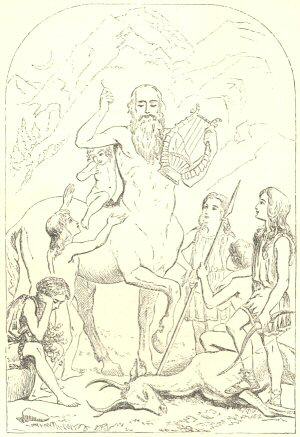
Only one walked apart and silent, Asclepius, the too-wisechild, with his bosom full of herbs and flowers, and round hiswrist a spotted snake; he came with downcast eyes to Cheiron, andwhispered how he had watched the snake cast its old skin, andgrow young again before his eyes, and how he had gone down into avillage in the vale, and cured a dying man with a herb which hehad seen a sick goat eat.
And Cheiron smiled, and said, ‘To each Athené andApollo give some gift, and each is worthy in his place; but tothis child they have given an honour beyond all honours, to curewhile others kill.’
Then the lads brought in wood, and split it, and lighted ablazing fire; and others skinned the deer and quartered them, andset them to roast before the fire; and while the venison wascooking they bathed in the snow-torrent, and washed away the dustand sweat.
And then all ate till they could eat no more (for they hadtasted nothing since the dawn), and drank of the clear springwater, for wine is not fit for growing lads. And when theremnants were put away, they all lay down upon the skins andleaves about the fire, and each took the lyre in turn, and sangand played with all his heart.
And after a while they all went out to a plot of grass at thecave’s mouth, and there they boxed, and ran, and wrestled,and laughed till the stones fell from the cliffs.
Then Cheiron took his lyre, and all the lads joined hands; andas be played, they danced to his measure, in and out, and roundand round. There they danced hand in hand, till the nightfell over land and sea, while the black glen shone with theirbroad white limbs and the gleam of their golden hair.
And the lad danced with them, delighted, and then slept awholesome sleep, upon fragrant leaves of bay, and myrtle, andmarjoram, and flowers of thyme; and rose at the dawn, and bathedin the torrent, and became a schoolfellow to the heroes’sons, and forgot Iolcos, and his father, and all his formerlife. But he grew strong, and brave and cunning, upon thepleasant downs of Pelion, in the keen hungry mountain air. And he learnt to wrestle, and to box, and to hunt, and to playupon the harp; and next he learnt to ride, for old Cheiron usedto mount him on his back; and he learnt the virtues of all herbsand how to cure all wounds; and Cheiron called him Jason thehealer, and that is his name until this day.
p.73PART II
HOW JASON LOST HIS SANDAL IN ANAUROS
And ten years came and went, and Jason was grown to be amighty man. Some of his fellows were gone, and some weregrowing up by his side. Asclepius was gone into Peloponneseto work his wondrous cures on men; and some say he used to raisethe dead to life. And Heracles was gone to Thebes to fulfilthose famous labours which have become a proverb among men. And Peleus had married a sea-nymph, and his wedding is famous tothis day. And Æneas was gone home to Troy, and many anoble tale you will read of him, and of all the other gallantheroes, the scholars of Cheiron the just. And it happenedon a day that Jason stood on the mountain, and looked north andsouth and east and west; and Cheiron stood by him and watchedhim, for he knew that the time was come.
And Jason looked and saw the plains of Thessaly, where theLapithai breed their horses; and the lake of Boibé, andthe stream which runs northward to Peneus and Tempe; and helooked north, and saw the mountain wall which guards theMagnesian shore; Olympus, the seat of the Immortals, and Ossa,and Pelion, where he stood. Then he looked east and saw thebright blue sea, which stretched away for ever toward thedawn. Then he looked south, and saw a pleasant land, withwhite-walled towns and farms, nestling along the shore of aland-locked bay, while the smoke rose blue among the trees; andhe knew it for the bay of Pagasai, and the rich lowlands ofHæmonia, and Iolcos by the sea.
Then he sighed, and asked, ‘Is it true what the heroestell me—that I am heir of that fair land?’
‘And what good would it be to you, Jason, if you wereheir of that fair land?’
‘I would take it and keep it.’
‘A strong man has taken it and kept it long. Areyou stronger than Pelias the terrible?’
‘I can try my strength with his,’ said Jason; butCheiron sighed, and said—
‘You have many a danger to go through before you rule inIolcos by the sea: many a danger and many a woe; and strangetroubles in strange lands, such as man never sawbefore.’
‘The happier I,’ said Jason, ‘to see whatman never saw before.’
And Cheiron sighed again, and said, ‘The eaglet mustleave the nest when it is fledged. Will you go to Iolcos bythe sea? Then promise me two things before yougo.’
Jason promised, and Cheiron answered, ‘Speak harshly tono soul whom you may meet, and stand by the word which you shallspeak.’
Jason wondered why Cheiron asked this of him; but he knew thatthe Centaur was a prophet, and saw things long before theycame. So he promised, and leapt down the mountain, to takehis fortune like a man.
He went down through the arbutus thickets, and across thedowns of thyme, till he came to the vineyard walls, and thepomegranates and the olives in the glen; and among the olivesroared Anauros, all foaming with a summer flood.
And on the bank of Anauros sat a woman, all wrinkled, gray,and old; her head shook palsied on her breast, and her handsshook palsied on her knees; and when she saw Jason, she spokewhining, ‘Who will carry me across the flood?’
Jason was bold and hasty, and was just going to leap into theflood: and yet he thought twice before he leapt, so loud roaredthe torrent down, all brown from the mountain rains, andsilver-veined with melting snow; while underneath he could hearthe boulders rumbling like the tramp of horsemen or the roll ofwheels, as they ground along the narrow channel, and shook therocks on which he stood.
But the old woman whined all the more, ‘I am weak andold, fair youth. For Hera’s sake, carry me over thetorrent.’
And Jason was going to answer her scornfully, whenCheiron’s words came to his mind.
So he said, ‘For Hera’s sake, the Queen of theImmortals on Olympus, I will carry you over the torrent, unlesswe both are drowned midway.’
Then the old dame leapt upon his back, as nimbly as a goat;and Jason staggered in, wondering; and the first step was up tohis knees.
The first step was up to his knees, and the second step was upto his waist; and the stones rolled about his feet, and his feetslipped about the stones; so he went on staggering, and panting,while the old woman cried from off his back—
‘Fool, you have wet my mantle! Do you make game ofpoor old souls like me?’
Jason had half a mind to drop her, and let her get through thetorrent by herself; but Cheiron’s words were in his mind,and he said only, ‘Patience, mother; the best horse maystumble some day.’
At last he staggered to the shore, and set her down upon thebank; and a strong man he needed to have been, or that wild waterhe never would have crossed.
He lay panting awhile upon the bank, and then leapt up to goupon his journey; but he cast one look at the old woman, for hethought, ‘She should thank me once at least.’
And as he looked, she grew fairer than all women, and tallerthan all men on earth; and her garments shone like the summersea, and her jewels like the stars of heaven; and over herforehead was a veil woven of the golden clouds of sunset; andthrough the veil she looked down on him, with great softheifer’s eyes; with great eyes, mild and awful, whichfilled all the glen with light.
And Jason fell upon his knees, and hid his face between hishands.
And she spoke, ‘I am the Queen of Olympus, Hera the wifeof Zeus. As thou hast done to me, so will I do tothee. Call on me in the hour of need, and try if theImmortals can forget.’
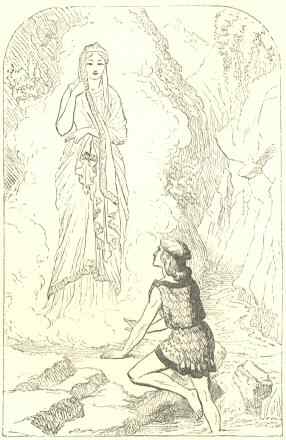
And when Jason looked up, she rose from off the earth, like apillar of tall white cloud, and floated away across the mountainpeaks, toward Olympus the holy hill.
Then a great fear fell on Jason: but after a while he grewlight of heart; and he blessed old Cheiron, and said,‘Surely the Centaur is a prophet, and guessed what wouldcome to pass, when he bade me speak harshly to no soul whom Imight meet.’
Then he went down toward Iolcos; and as he walked he foundthat he had lost one of his sandals in the flood.
And as he went through the streets, the people came out tolook at him, so tall and fair was he; but some of the elderswhispered together; and at last one of them stopped Jason, andcalled to him, ‘Fair lad, who are you, and whence come you;and what is your errand in the town?’
‘My name, good father, is Jason, and I come from Pelionup above; and my errand is to Pelias your king; tell me thenwhere his palace is.’
But the old man started, and grew pale, and said, ‘Doyou not know the oracle, my son, that you go so boldly throughthe town with but one sandal on?’
‘I am a stranger here, and know of no oracle; but whatof my one sandal? I lost the other in Anauros, while I wasstruggling with the flood.’
Then the old man looked back to his companions; and onesighed, and another smiled; at last he said, ‘I will tellyou, lest you rush upon your ruin unawares. The oracle inDelphi has said that a man wearing one sandal should take thekingdom from Pelias, and keep it for himself. Thereforebeware how you go up to his palace, for he is the fiercest andmost cunning of all kings.’
Then Jason laughed a great laugh, like a war-horse in hispride. ‘Good news, good father, both for you andme. For that very end I came into the town.’
Then he strode on toward the palace of Pelias, while all thepeople wondered at his bearing.
And he stood in the doorway and cried, ‘Come out, comeout, Pelias the valiant, and fight for your kingdom like aman.’
Pelias came out wondering, and ‘Who are you, boldyouth?’ he cried.
‘I am Jason, the son of Æson, the heir of all thisland.’
Then Pelias lifted up his hands and eyes, and wept, or seemedto weep; and blessed the heavens which had brought his nephew tohim, never to leave him more. ‘For,’ said he,‘I have but three daughters, and no son to be myheir. You shall be my heir then, and rule the kingdom afterme, and marry whichsoever of my daughters you shall choose;though a sad kingdom you will find it, and whosoever rules it amiserable man. But come in, come in, and feast.’
So he drew Jason in, whether he would or not, and spoke to himso lovingly and feasted him so well, that Jason’s angerpassed; and after supper his three cousins came into the hall,and Jason thought that he should like well enough to have one ofthem for his wife.
But at last he said to Pelias, ‘Why do you look so sad,my uncle? And what did you mean just now when you said thatthis was a doleful kingdom, and its ruler a miserableman?’
Then Pelias sighed heavily again and again and again, like aman who had to tell some dreadful story, and was afraid to begin;but at last—
‘For seven long years and more have I never known aquiet night; and no more will he who comes after me, till thegolden fleece be brought home.’
Then he told Jason the story of Phrixus, and of the goldenfleece; and told him, too, which was a lie, that Phrixus’spirit tormented him, calling to him day and night. And hisdaughters came, and told the same tale (for their father hadtaught them their parts), and wept, and said, ‘Oh who willbring home the golden fleece, that our uncle’s spirit mayrest; and that we may have rest also, whom he never lets sleep inpeace?’
Jason sat awhile, sad and silent; for he had often heard ofthat golden fleece; but he looked on it as a thing hopeless andimpossible for any mortal man to win it.
But when Pelias saw him silent, he began to talk of otherthings, and courted Jason more and more, speaking to him as if hewas certain to be his heir, and asking his advice about thekingdom; till Jason, who was young and simple, could not helpsaying to himself, ‘Surely he is not the dark man whompeople call him. Yet why did he drive my fatherout?’ And he asked Pelias boldly, ‘Men say thatyou are terrible, and a man of blood; but I find you a kind andhospitable man; and as you are to me, so will I be to you. Yet why did you drive my father out?’
Pelias smiled, and sighed. ‘Men have slandered mein that, as in all things. Your father was growing old andweary, and he gave the kingdom up to me of his own will. You shall see him to-morrow, and ask him; and he will tell youthe same.’
Jason’s heart leapt in him when he heard that he was tosee his father; and he believed all that Pelias said, forgettingthat his father might not dare to tell the truth.
‘One thing more there is,’ said Pelias, ‘onwhich I need your advice; for, though you are young, I see in youa wisdom beyond your years. There is one neighbour of mine,whom I dread more than all men on earth. I am stronger thanhe now, and can command him; but I know that if he stay among us,he will work my ruin in the end. Can you give me a plan,Jason, by which I can rid myself of that man?’
After awhile Jason answered, half laughing, ‘Were I you,I would send him to fetch that same golden fleece; for if he onceset forth after it you would never be troubled with himmore.’
And at that a bitter smile came across Pelias’ lips, anda flash of wicked joy into his eyes; and Jason saw it, andstarted; and over his mind came the warning of the old man, andhis own one sandal, and the oracle, and he saw that he was takenin a trap.
But Pelias only answered gently, ‘My son, he shall besent forthwith.’
‘You mean me?’ cried Jason, starting up,‘because I came here with one sandal?’ And helifted his fist angrily, while Pelias stood up to him like a wolfat bay; and whether of the two was the stronger and the fiercerit would be hard to tell.
But after a moment Pelias spoke gently, ‘Why then sorash, my son? You, and not I, have said what is said; whyblame me for what I have not done? Had you bid me love theman of whom I spoke, and make him my son-in-law and heir, I wouldhave obeyed you; and what if I obey you now, and send the man towin himself immortal fame? I have not harmed you, orhim. One thing at least I know, that he will go, and thatgladly; for he has a hero’s heart within him, loving glory,and scorning to break the word which he has given.’
Jason saw that he was entrapped; but his second promise toCheiron came into his mind, and he thought, ‘What if theCentaur were a prophet in that also, and meant that I should winthe fleece!’ Then he cried aloud—
‘You have well spoken, cunning uncle of mine! Ilove glory, and I dare keep to my word. I will go and fetchthis golden fleece. Promise me but this in return, and keepyour word as I keep mine. Treat my father lovingly while Iam gone, for the sake of the all-seeing Zeus; and give me up thekingdom for my own on the day that I bring back the goldenfleece.’
Then Pelias looked at him and almost loved him, in the midstof all his hate; and said, ‘I promise, and I willperform. It will be no shame to give up my kingdom to theman who wins that fleece.’ Then they swore a greatoath between them; and afterwards both went in, and lay down tosleep.
But Jason could not sleep for thinking of his mighty oath, andhow he was to fulfil it, all alone, and without wealth orfriends. So he tossed a long time upon his bed, and thoughtof this plan and of that; and sometimes Phrixus seemed to callhim, in a thin voice, faint and low, as if it came from faracross the sea, ‘Let me come home to my fathers and haverest.’ And sometimes he seemed to see the eyes ofHera, and to hear her words again—‘Call on me in thehour of need, and see if the Immortals can forget.’
And on the morrow he went to Pelias, and said, ‘Give mea victim, that I may sacrifice to Hera.’ So he wentup, and offered his sacrifice; and as he stood by the altar Herasent a thought into his mind; and he went back to Pelias, andsaid—
‘If you are indeed in earnest, give me two heralds, thatthey may go round to all the princes of the Minuai, who werepupils of the Centaur with me, that we may fit out a shiptogether, and take what shall befall.’
At that Pelias praised his wisdom, and hastened to send theheralds out; for he said in his heart, ‘Let all the princesgo with him, and, like him, never return; for so I shall be lordof all the Minuai, and the greatest king in Hellas.’
p.87PART III
HOW THEY BUILT THE SHIP ‘ARGO’ IN IOLCOS
So the heralds went out, and cried to all the heroes of theMinuai, ‘Who dare come to the adventure of the goldenfleece?’
And Hera stirred the hearts of all the princes, and they camefrom all their valleys to the yellow sands of Pagasai. Andfirst came Heracles the mighty, with his lion’s skin andclub, and behind him Hylas his young squire, who bore his arrowsand his bow; and Tiphys, the skilful steersman; and Butes, thefairest of all men; and Castor and Polydeuces the twins, the sonsof the magic swan; and Cæneus, the strongest of mortals,whom the Centaurs tried in vain to kill, and overwhelmed him withtrunks of pine-trees, but even so he would not die; and thithercame Zetes and Calais, the winged sons of the north wind; andPeleus, the father of Achilles, whose bride was silver-footedThetis, the goddess of the sea. And thither came Telamonand Oileus, the fathers of the two Aiantes, who fought upon theplains of Troy; and Mopsus, the wise soothsayer, who knew thespeech of birds; and Idmon, to whom Phoebus gave a tongue toprophesy of things to come; and Ancaios, who could read thestars, and knew all the circles of the heavens; and Argus, thefamed shipbuilder, and many a hero more, in helmets of brass andgold with tall dyed horse-hair crests, and embroidered shirts oflinen beneath their coats of mail, and greaves of polished tin toguard their knees in fight; with each man his shield upon hisshoulder, of many a fold of tough bull’s hide, and hissword of tempered bronze in his silver-studded belt; and in hisright hand a pair of lances, of the heavy white ash-staves.
So they came down to Iolcos, and all the city came out to meetthem, and were never tired with looking at their height, andtheir beauty, and their gallant bearing and the glitter of theirinlaid arms. And some said, ‘Never was such agathering of the heroes since the Hellens conquered theland.’ But the women sighed over them, and whispered,‘Alas! they are all going to their death!’
Then they felled the pines on Pelion, and shaped them with theaxe, and Argus taught them to build a galley, the first long shipwhich ever sailed the seas. They pierced her for fiftyoars—an oar for each hero of the crew—and pitched herwith coal-black pitch, and painted her bows with vermilion; andthey named her Argoafter Argus, and worked at her all daylong. And at night Pelias feasted them like a king, andthey slept in his palace-porch.
But Jason went away to the northward, and into the land ofThrace, till he found Orpheus, the prince of minstrels, where hedwelt in his cave under Rhodope, among the savage Cicontribes. And he asked him, ‘Will you leave yourmountains, Orpheus, my fellow-scholar in old times, and crossStrymon once more with me, to sail with the heroes of the Minuai,and bring home the golden fleece, and charm for us all men andall monsters with your magic harp and song?’
Then Orpheus sighed, ‘Have I not had enough of toil andof weary wandering, far and wide since I lived in Cheiron’scave, above Iolcos by the sea? In vain is the skill and thevoice which my goddess mother gave me; in vain have I sung andlaboured; in vain I went down to the dead, and charmed all thekings of Hades, to win back Eurydice my bride. For I wonher, my beloved, and lost her again the same day, and wanderedaway in my madness, even to Egypt and the Libyan sands, and theisles of all the seas, driven on by the terrible gadfly, while Icharmed in vain the hearts of men, and the savage forest beasts,and the trees, and the lifeless stones, with my magic harp andsong, giving rest, but finding none. But at last Calliopemy mother delivered me, and brought me home in peace; and I dwellhere in the cave alone, among the savage Cicon tribes, softeningtheir wild hearts with music and the gentle laws of Zeus. And now I must go out again, to the ends of all the earth, faraway into the misty darkness, to the last wave of the EasternSea. But what is doomed must be, and a friend’sdemand obeyed; for prayers are the daughters of Zeus, and whohonours them honours him.’
Then Orpheus rose up sighing, and took his harp, and went overStrymon. And he led Jason to the south-west, up the banksof Haliacmon and over the spurs of Pindus, to Dodona the town ofZeus, where it stood by the side of the sacred lake, and thefountain which breathed out fire, in the darkness of the ancientoakwood, beneath the mountain of the hundred springs. Andhe led him to the holy oak, where the black dove settled in oldtimes, and was changed into the priestess of Zeus, and gaveoracles to all nations round. And he bade him cut down abough, and sacrifice to Hera and to Zeus; and they took the boughand came to Iolcos, and nailed it to the beak-head of theship.
And at last the ship was finished, and they tried to launchher down the beach; but she was too heavy for them to move her,and her keel sank deep into the sand. Then all the heroeslooked at each other blushing; but Jason spoke, and said,‘Let us ask the magic bough; perhaps it can help us in ourneed.’
Then a voice came from the bough, and Jason heard the words itsaid, and bade Orpheus play upon the harp, while the heroeswaited round, holding the pine-trunk rollers, to help her towardthe sea.
Then Orpheus took his harp, and began his magicsong—‘How sweet it is to ride upon the surges, and toleap from wave to wave, while the wind sings cheerful in thecordage, and the oars flash fast among the foam! How sweetit is to roam across the ocean, and see new towns and wondrouslands, and to come home laden with treasure, and to win undyingfame!’
And the good ship Argoheard him, and longed to be awayand out at sea; till she stirred in every timber, and heaved fromstem to stern, and leapt up from the sand upon the rollers, andplunged onward like a gallant horse; and the heroes fed her pathwith pine-trunks, till she rushed into the whispering sea.
Then they stored her well with food and water, and pulled theladder up on board, and settled themselves each man to his oar,and kept time to Orpheus’ harp; and away across the baythey rowed southward, while the people lined the cliffs; and thewomen wept, while the men shouted, at the starting of thatgallant crew.
p.93PART IV
HOW THE ARGONAUTS SAILED TO COLCHIS
And what happened next, my children, whether it be true ornot, stands written in ancient songs, which you shall read foryourselves some day. And grand old songs they are, writtenin grand old rolling verse; and they call them the Songs ofOrpheus, or the Orphics, to this day. And they tell how theheroes came to Aphetai, across the bay, and waited for thesouth-west wind, and chose themselves a captain from their crew:and how all called for Heracles, because he was the strongest andmost huge; but Heracles refused, and called for Jason, because hewas the wisest of them all. So Jason was chosen captain;and Orpheus heaped a pile of wood, and slew a bull, and offeredit to Hera, and called all the heroes to stand round, eachman’s head crowned with olive, and to strike their swordsinto the bull. Then he filled a golden goblet with thebull’s blood, and with wheaten flour, and honey, and wine,and the bitter salt-sea water, and bade the heroes taste. So each tasted the goblet, and passed it round, and vowed anawful vow: and they vowed before the sun, and the night, and theblue-haired sea who shakes the land, to stand by Jason faithfullyin the adventure of the golden fleece; and whosoever shrank back,or disobeyed, or turned traitor to his vow, then justice shouldminister against him, and the Erinnues who track guilty men.
Then Jason lighted the pile, and burnt the carcase of thebull; and they went to their ship and sailed eastward, like menwho have a work to do; and the place from which they went wascalled Aphetai, the sailing-place, from that day forth. Three thousand years and more they sailed away, into the unknownEastern seas; and great nations have come and gone since then,and many a storm has swept the earth; and many a mighty armament,to which Argowould be but one small boat; English andFrench, Turkish and Russian, have sailed those waters since; yetthe fame of that small Argolives for ever, and her nameis become a proverb among men.
So they sailed past the Isle of Sciathos, with the Cape ofSepius on their left, and turned to the northward toward Pelion,up the long Magnesian shore. On their right hand was theopen sea, and on their left old Pelion rose, while the cloudscrawled round his dark pine-forests, and his caps of summersnow. And their hearts yearned for the dear old mountain,as they thought of pleasant days gone by, and of the sports oftheir boyhood, and their hunting, and their schooling in the cavebeneath the cliff. And at last Peleus spoke, ‘Let usland here, friends, and climb the dear old hill once more. We are going on a fearful journey; who knows if we shall seePelion again? Let us go up to Cheiron our master, and askhis blessing ere we start. And I have a boy, too, with him,whom he trains as he trained me once—the son whom Thetisbrought me, the silver-footed lady of the sea, whom I caught inthe cave, and tamed her, though she changed her shape seventimes. For she changed, as I held her, into water, and tovapour, and to burning flame, and to a rock, and to a black-manedlion, and to a tall and stately tree. But I held her andheld her ever, till she took her own shape again, and led her tomy father’s house, and won her for my bride. And allthe rulers of Olympus came to our wedding, and the heavens andthe earth rejoiced together, when an Immortal wedded mortalman. And now let me see my son; for it is not often I shallsee him upon earth: famous he will be, but short-lived, and diein the flower of youth.’
So Tiphys the helmsman steered them to the shore under thecrags of Pelion; and they went up through the dark pine-foreststowards the Centaur’s cave.
And they came into the misty hall, beneath the snow-crownedcrag; and saw the great Centaur lying, with his huge limbs spreadupon the rock; and beside him stood Achilles, the child whom nosteel could wound, and played upon his harp right sweetly, whileCheiron watched and smiled.
Then Cheiron leapt up and welcomed them, and kissed them everyone, and set a feast before them of swine’s flesh, andvenison, and good wine; and young Achilles served them, andcarried the golden goblet round. And after supper all theheroes clapped their hands, and called on Orpheus to sing; but herefused, and said, ‘How can I, who am the younger, singbefore our ancient host?’ So they called on Cheironto sing, and Achilles brought him his harp; and he began awondrous song; a famous story of old time, of the fight betweenthe Centaurs and the Lapithai, which you may still see carved instone. [96] He sang how his brothers came toruin by their folly, when they were mad with wine; and how theyand the heroes fought, with fists, and teeth, and the gobletsfrom which they drank; and how they tore up the pine-trees intheir fury, and hurled great crags of stone, while the mountainsthundered with the battle, and the land was wasted far and wide;till the Lapithai drove them from their home in the richThessalian plains to the lonely glens of Pindus, leaving Cheironall alone. And the heroes praised his song right heartily;for some of them had helped in that great fight.
Then Orpheus took the lyre, and sang of Chaos, and the makingof the wondrous World, and how all things sprang from Love, whocould not live alone in the Abyss. And as he sang, hisvoice rose from the cave, above the crags, and through thetree-tops, and the glens of oak and pine. And the treesbowed their heads when they heard it, and the gray rocks crackedand rang, and the forest beasts crept near to listen, and thebirds forsook their nests and hovered round. And oldCheiron claps his hands together, and beat his hoofs upon theground, for wonder at that magic song.
Then Peleus kissed his boy, and wept over him, and they wentdown to the ship; and Cheiron came down with them, weeping, andkissed them one by one, and blest them, and promised to themgreat renown. And the heroes wept when they left him, tilltheir great hearts could weep no more; for he was kind and justand pious, and wiser than all beasts and men. Then he wentup to a cliff, and prayed for them, that they might come homesafe and well; while the heroes rowed away, and watched himstanding on his cliff above the sea, with his great hands raisedtoward heaven, and his white locks waving in the wind; and theystrained their eyes to watch him to the last, for they felt thatthey should look on him no more.
So they rowed on over the long swell of the sea, past Olympus,the seat of the Immortals, and past the wooded bays of Athos, andSamothrace the sacred isle; and they came past Lemnos to theHellespont, and through the narrow strait of Abydos, and so oninto the Propontis, which we call Marmora now. And therethey met with Cyzicus, ruling in Asia over the Dolions, who, thesongs say, was the son of Æneas, of whom you will hear manya tale some day. For Homer tells us how he fought at Troy,and Virgil how he sailed away and founded Rome; and men believeduntil late years that from him sprang our old Britishkings. Now Cyzicus, the songs say, welcomed the heroes, forhis father had been one of Cheiron’s scholars; so hewelcomed them, and feasted them, and stored their ship with cornand wine, and cloaks and rugs, the songs say, and shirts, ofwhich no doubt they stood in need.
But at night, while they lay sleeping, came down on themterrible men, who lived with the bears in the mountains, likeTitans or giants in shape; for each of them had six arms, andthey fought with young firs and pines. But Heracles killedthem all before morn with his deadly poisoned arrows; but amongthem, in the darkness, he slew Cyzicus the kindly prince.
Then they got to their ship and to their oars, and Tiphys badethem cast off the hawsers and go to sea. But as he spoke awhirlwind came, and spun the Argoround, and twisted thehawsers together, so that no man could loose them. ThenTiphys dropped the rudder from his hand, and cried, ‘Thiscomes from the Gods above.’ But Jason went forward,and asked counsel of the magic bough.
Then the magic bough spoke, and answered, ‘This isbecause you have slain Cyzicus your friend. You mustappease his soul, or you will never leave this shore.’
Jason went back sadly, and told the heroes what he hadheard. And they leapt on shore, and searched till dawn; andat dawn they found the body, all rolled in dust and blood, amongthe corpses of those monstrous beasts. And they wept overtheir kind host, and laid him on a fair bed, and heaped a hugemound over him, and offered black sheep at his tomb, and Orpheussang a magic song to him, that his spirit might have rest. And then they held games at the tomb, after the custom of thosetimes, and Jason gave prizes to each winner. ToAncæus he gave a golden cup, for he wrestled best of all;and to Heracles a silver one, for he was the strongest of all;and to Castor, who rode best, a golden crest; and Polydeuces theboxer had a rich carpet, and to Orpheus for his song a sandalwith golden wings. But Jason himself was the best of allthe archers, and the Minuai crowned him with an olive crown; andso, the songs say, the soul of good Cyzicus was appeased and theheroes went on their way in peace.
But when Cyzicus’ wife heard that he was dead she diedlikewise of grief; and her tears became a fountain of clearwater, which flows the whole year round.
Then they rowed away, the songs say, along the Mysian shore,and past the mouth of Rhindacus, till they found a pleasant bay,sheltered by the long ridges of Arganthus, and by high walls ofbasalt rock. And there they ran the ship ashore upon theyellow sand, and furled the sail, and took the mast down, andlashed it in its crutch. And next they let down the ladder,and went ashore to sport and rest.
And there Heracles went away into the woods, bow in hand, tohunt wild deer; and Hylas the fair boy slipt away after him, andfollowed him by stealth, until he lost himself among the glens,and sat down weary to rest himself by the side of a lake; andthere the water nymphs came up to look at him, and loved him, andcarried him down under the lake to be their playfellow, for everhappy and young. And Heracles sought for him in vain,shouting his name till all the mountains rang; but Hylas neverheard him, far down under the sparkling lake. So whileHeracles wandered searching for him, a fair breeze sprang up, andHeracles was nowhere to be found; and the Argosailedaway, and Heracles was left behind, and never saw the noblePhasian stream.
Then the Minuai came to a doleful land, where Amycus the giantruled, and cared nothing for the laws of Zeus, but challenged allstrangers to box with him, and those whom he conquered heslew. But Polydeuces the boxer struck him a harder blowthan he ever felt before, and slew him; and the Minuai went on upthe Bosphorus, till they came to the city of Phineus, the fierceBithynian king; for Zetes and Calais bade Jason land there,because they had a work to do.
And they went up from the shore toward the city, throughforests white with snow; and Phineus came out to meet them with alean and woful face, and said, ‘Welcome, gallant heroes, tothe land of bitter blasts, the land of cold and misery; yet Iwill feast you as best I can.’ And he led them in,and set meat before them; but before they could put their handsto their mouths, down came two fearful monsters, the like of whomman never saw; for they had the faces and the hair of fairmaidens, but the wings and claws of hawks; and they snatched themeat from off the table, and flew shrieking out above theroofs.
Then Phineus beat his breast and cried, ‘These are theHarpies, whose names are the Whirlwind and the Swift, thedaughters of Wonder and of the Amber-nymph, and they rob us nightand day. They carried off the daughters of Pandareus, whomall the Gods had blest; for Aphrodite fed them on Olympus withhoney and milk and wine; and Hera gave them beauty and wisdom,and Athené skill in all the arts; but when they came totheir wedding, the Harpies snatched them both away, and gave themto be slaves to the Erinnues, and live in horror all theirdays. And now they haunt me, and my people, and theBosphorus, with fearful storms; and sweep away our food from offour tables, so that we starve in spite of all ourwealth.’
Then up rose Zetes and Calais, the winged sons of theNorth-wind, and said, ‘Do you not know us, Phineus, andthese wings which grow upon our backs?’ And Phineushid his face in terror; but he answered not a word.
‘Because you have been a traitor, Phineus, the Harpieshaunt you night and day. Where is Cleopatra our sister,your wife, whom you keep in prison? and where are her twochildren, whom you blinded in your rage, at the bidding of anevil woman, and cast them out upon the rocks? Swear to usthat you will right our sister, and cast out that wicked woman;and then we will free you from your plague, and drive thewhirlwind maidens to the south; but if not, we will put out youreyes, as you put out the eyes of your own sons.’
Then Phineus swore an oath to them, and drove out the wickedwoman; and Jason took those two poor children, and cured theireyes with magic herbs.
But Zetes and Calais rose up sadly and said, ‘Farewellnow, heroes all; farewell, our dear companions, with whom weplayed on Pelion in old times; for a fate is laid upon us, andour day is come at last, in which we must hunt the whirlwindsover land and sea for ever; and if we catch them they die, and ifnot, we die ourselves.’
At that all the heroes wept; but the two young men sprang up,and aloft into the air after the Harpies, and the battle of thewinds began.
The heroes trembled in silence as they heard the shrieking ofthe blasts; while the palace rocked and all the city, and greatstones were torn from the crags, and the forest pines were hurledearthward, north and south and east and west, and the Bosphorusboiled white with foam, and the clouds were dashed against thecliffs.
But at last the battle ended, and the Harpies fled screamingtoward the south, and the sons of the North-wind rushed afterthem, and brought clear sunshine where they passed. Formany a league they followed them, over all the isles of theCyclades, and away to the south-west across Hellas, till theycame to the Ionian Sea, and there they fell upon the Echinades,at the mouth of the Achelous; and those isles were called theWhirlwind Isles for many a hundred years. But what becameof Zetes and Calais I know not, for the heroes never saw themagain: and some say that Heracles met them, and quarrelled withthem, and slew them with his arrows; and some say that they felldown from weariness and the heat of the summer sun, and that theSun-god buried them among the Cyclades, in the pleasant Isle ofTenos; and for many hundred years their grave was shown there,and over it a pillar, which turned to every wind. But thosedark storms and whirlwinds haunt the Bosphorus until thisday.
But the Argonauts went eastward, and out into the open sea,which we now call the Black Sea, but it was called the Euxinethen. No Hellen had ever crossed it, and all feared thatdreadful sea, and its rocks, and shoals, and fogs, and bitterfreezing storms; and they told strange stories of it, some falseand some half-true, how it stretched northward to the ends of theearth, and the sluggish Putrid Sea, and the everlasting night,and the regions of the dead. So the heroes trembled, forall their courage, as they came into that wild Black Sea, and sawit stretching out before them, without a shore, as far as eyecould see.
And first Orpheus spoke, and warned them, ‘We shall comenow to the wandering blue rocks; my mother warned me of them,Calliope, the immortal muse.’
And soon they saw the blue rocks shining like spires andcastles of gray glass, while an ice-cold wind blew from them andchilled all the heroes’ hearts. And as they nearedthey could see them heaving, as they rolled upon the longsea-waves, crashing and grinding together, till the roar went upto heaven. The sea sprang up in spouts between them, andswept round them in white sheets of foam; but their heads swungnodding high in air, while the wind whistled shrill among thecrags.
The heroes’ hearts sank within them, and they lay upontheir oars in fear; but Orpheus called to Tiphys the helmsman,‘Between them we must pass; so look ahead for an opening,and be brave, for Hera is with us.’ But Tiphys thecunning helmsman stood silent, clenching his teeth, till he saw aheron come flying mast-high toward the rocks, and hover awhilebefore them, as if looking for a passage through. Then hecried, ‘Hera has sent us a pilot; let us follow the cunningbird.’
Then the heron flapped to and fro a moment, till he saw ahidden gap, and into it he rushed like an arrow, while the heroeswatched what would befall.
And the blue rocks clashed together as the bird fled swiftlythrough; but they struck but a feather from his tail, and thenrebounded apart at the shock.
Then Tiphys cheered the heroes, and they shouted; and the oarsbent like withes beneath their strokes as they rushed betweenthose toppling ice-crags and the cold blue lips of death. And ere the rocks could meet again they had passed them, and weresafe out in the open sea.
And after that they sailed on wearily along the Asian coast,by the Black Cape and Thyneis, where the hot stream of Thymbrisfalls into the sea, and Sangarius, whose waters float on theEuxine, till they came to Wolf the river, and to Wolf the kindlyking. And there died two brave heroes, Idmon and Tiphys thewise helmsman: one died of an evil sickness, and one a wild boarslew. So the heroes heaped a mound above them, and set uponit an oar on high, and left them there to sleep together, on thefar-off Lycian shore. But Idas killed the boar, and avengedTiphys; and Ancaios took the rudder and was helmsman, and steeredthem on toward the east.
And they went on past Sinope, and many a mighty river’smouth, and past many a barbarous tribe, and the cities of theAmazons, the warlike women of the East, till all night they heardthe clank of anvils and the roar of furnace-blasts, and theforge-fires shone like sparks through the darkness in themountain glens aloft; for they were come to the shores of theChalybes, the smiths who never tire, but serve Ares the cruelWar-god, forging weapons day and night.
And at day-dawn they looked eastward, and midway between thesea and the sky they saw white snow-peaks hanging, glitteringsharp and bright above the clouds. And they knew that theywere come to Caucasus, at the end of all the earth: Caucasus thehighest of all mountains, the father of the rivers of theEast. On his peak lies chained the Titan, while a vulturetears his heart; and at his feet are piled dark forests round themagic Colchian land.
And they rowed three days to the eastward, while Caucasus rosehigher hour by hour, till they saw the dark stream of Phasisrushing headlong to the sea, and, shining above the tree-tops,the golden roofs of King Aietes, the child of the Sun.
Then out spoke Ancaios the helmsman, ‘We are come to ourgoal at last, for there are the roofs of Aietes, and the woodswhere all poisons grow; but who can tell us where among them ishid the golden fleece? Many a toil must we bear ere we findit, and bring it home to Greece.’
But Jason cheered the heroes, for his heart was high and bold;and he said, ‘I will go alone up to Aietes, though he bethe child of the Sun, and win him with soft words. Betterso than to go altogether, and to come to blows atonce.’ But the Minuai would not stay behind, so theyrowed boldly up the stream.
And a dream came to Aietes, and filled his heart withfear. He thought he saw a shining star, which fell into hisdaughter’s lap; and that Medeia his daughter took itgladly, and carried it to the river-side, and cast it in, andthere the whirling river bore it down, and out into the EuxineSea.
Then he leapt up in fear, and bade his servants bring hischariot, that he might go down to the river-side and appease thenymphs, and the heroes whose spirits haunt the bank. So hewent down in his golden chariot, and his daughters by his side,Medeia the fair witch-maiden, and Chalciope, who had beenPhrixus’ wife, and behind him a crowd of servants andsoldiers, for he was a rich and mighty prince.
And as he drove down by the reedy river he saw Argosliding up beneath the bank, and many a hero in her, likeImmortals for beauty and for strength, as their weapons glitteredround them in the level morning sunlight, through the white mistof the stream. But Jason was the noblest of all; for Hera,who loved him, gave him beauty and tallness and terriblemanhood.
And when they came near together and looked into eachother’s eyes the heroes were awed before Aietes as he shonein his chariot, like his father the glorious Sun; for his robeswere of rich gold tissue, and the rays of his diadem flashedfire; and in his hand he bore a jewelled sceptre, which glitteredlike the stars; and sternly he looked at them under his brows,and sternly he spoke and loud—
‘Who are you, and what want you here, that you come tothe shore of Cutaia? Do you take no account of my rule, norof my people the Colchians who serve me, who never tired yet inthe battle, and know well how to face an invader?’
And the heroes sat silent awhile before the face of thatancient king. But Hera the awful goddess put courage intoJason’s heart, and he rose and shouted loudly in answer,‘We are no pirates nor lawless men. We come not toplunder and to ravage, or carry away slaves from your land; butmy uncle, the son of Poseidon, Pelias the Minuan king, he it iswho has set me on a quest to bring home the golden fleece. And these too, my bold comrades, they are no nameless men; forsome are the sons of Immortals, and some of heroes farrenowned. And we too never tire in battle, and know wellhow to give blows and to take: yet we wish to be guests at yourtable: it will be better so for both.’
Then Aietes’ race rushed up like a whirlwind, and hiseyes flashed fire as he heard; but he crushed his anger down inhis breast, and spoke mildly a cunning speech—
‘If you will fight for the fleece with my Colchians,then many a man must die. But do you indeed expect to winfrom me the fleece in fight? So few you are that if you beworsted I can load your ship with your corpses. But if youwill be ruled by me, you will find it better far to choose thebest man among you, and let him fulfil the labours which Idemand. Then I will give him the golden fleece for a prizeand a glory to you all.’
So saying, he turned his horses and drove back in silence tothe town. And the Minuai sat silent with sorrow, and longedfor Heracles and his strength; for there was no facing thethousands of the Colchians and the fearful chance of war.
But Chalciope, Phrixus’ widow, went weeping to the town;for she remembered her Minuan husband, and all the pleasures ofher youth, while she watched the fair faces of his kinsmen, andtheir long locks of golden hair. And she whispered toMedeia her sister, ‘Why should all these brave men die? whydoes not my father give them up the fleece, that myhusband’s spirit may have rest?’
And Medeia’s heart pitied the heroes, and Jason most ofall; and she answered, ‘Our father is stern and terrible,and who can win the golden fleece?’ But Chalciopesaid, ‘These men are not like our men; there is nothingwhich they cannot dare nor do.’
And Medeia thought of Jason and his brave countenance, andsaid, ‘If there was one among them who knew no fear, Icould show him how to win the fleece.’
So in the dusk of evening they went down to the river-side,Chalciope and Medeia the witch-maiden, and Argus, Phrixus’son. And Argus the boy crept forward, among the beds ofreeds, till he came where the heroes were sleeping, on thethwarts of the ship, beneath the bank, while Jason kept ward onshore, and leant upon his lance full of thought. And theboy came to Jason, and said—
‘I am the son of Phrixus, your Cousin; and Chalciope mymother waits for you, to talk about the golden fleece.’
Then Jason went boldly with the boy, and found the twoprincesses standing; and when Chalciope saw him she wept, andtook his hands, and cried—‘O cousin of my beloved, gohome before you die!’
‘It would be base to go home now, fair princess, and tohave sailed all these seas in vain.’ Then both theprincesses besought him; but Jason said, ‘It is toolate.’
‘But you know not,’ said Medeia, ‘what hemust do who would win the fleece. He must tame the twobrazen-footed bulls, who breathe devouring flame; and with themhe must plough ere nightfall four acres in the field of Ares; andhe must sow them with serpents’ teeth, of which each toothsprings up into an armed man. Then he must fight with allthose warriors; and little will it profit him to conquer them,for the fleece is guarded by a serpent, more huge than anymountain pine; and over his body you must step if you would reachthe golden fleece.’
Then Jason laughed bitterly. ‘Unjustly is thatfleece kept here, and by an unjust and lawless king; and unjustlyshall I die in my youth, for I will attempt it ere another sun beset.’
Then Medeia trembled, and said, ‘No mortal man can reachthat fleece unless I guide him through. For round it,beyond the river, is a wall full nine ells high, with loftytowers and buttresses, and mighty gates of threefold brass; andover the gates the wall is arched, with golden battlementsabove. And over the gateway sits Brimo, the wildwitch-huntress of the woods, brandishing a pine-torch in herhands, while her mad hounds howl around. No man dare meether or look on her, but only I her priestess, and she watches farand wide lest any stranger should come near.’
‘No wall so high but it may be climbed at last, and nowood so thick but it may be crawled through; no serpent so warybut he may be charmed, or witch-queen so fierce but spells maysoothe her; and I may yet win the golden fleece, if a wise maidenhelp bold men.’
And he looked at Medeia cunningly, and held her with hisglittering eye, till she blushed and trembled, andsaid—
‘Who can face the fire of the bulls’ breath, andfight ten thousand armed men?’
‘He whom you help,’ said Jason, flattering her,‘for your fame is spread over all the earth. Are younot the queen of all enchantresses, wiser even than your sisterCirce, in her fairy island in the West?’
‘Would that I were with my sister Circe in her fairyisland in the West, far away from sore temptation and thoughtswhich tear the heart! But if it must be so—for whyshould you die?—I have an ointment here; I made it from themagic ice-flower which sprang from Prometheus’ wound, abovethe clouds on Caucasus, in the dreary fields of snow. Anoint yourself with that, and you shall have in you sevenmen’s strength; and anoint your shield with it, and neitherfire nor sword can harm you. But what you begin you mustend before sunset, for its virtue lasts only one day. Andanoint your helmet with it before you sow the serpents’teeth; and when the sons of earth spring up, cast your helmetamong their ranks, and the deadly crop of the War-god’sfield will mow itself, and perish.’
Then Jason fell on his knees before her, and thanked her andkissed her hands; and she gave him the vase of ointment, and fledtrembling through the reeds. And Jason told his comradeswhat had happened, and showed them the box of ointment; and allrejoiced but Idas, and he grew mad with envy.
And at sunrise Jason went and bathed, and anointed himselffrom head to foot, and his shield, and his helmet, and hisweapons, and bade his comrades try the spell. So they triedto bend his lance, but it stood like an iron bar; and Idas inspite hewed at it with his sword, but the blade flew to splintersin his face. Then they hurled their lances at his shield,but the spear-points turned like lead; and Caineus tried to throwhim, but he never stirred a foot; and Polydeuces struck him withhis fist a blow which would have killed an ox, but Jason onlysmiled, and the heroes danced about him with delight; and heleapt, and ran, and shouted in the joy of that enormous strength,till the sun rose, and it was time to go and to claimAietes’ promise.
So he sent up Telamon and Aithalides to tell Aietes that hewas ready for the fight; and they went up among the marble walls,and beneath the roofs of gold, and stood in Aietes’ hall,while he grew pale with rage.
‘Fulfil your promise to us, child of the blazingSun. Give us the serpents’ teeth, and let loose thefiery bulls; for we have found a champion among us who can winthe golden fleece.’
And Aietes bit his lips, for he fancied that they had fledaway by night: but he could not go back from his promise; so hegave them the serpents’ teeth.
Then he called for his chariot and his horses, and sentheralds through all the town; and all the people went out withhim to the dreadful War-god’s field.
And there Aietes sat upon his throne, with his warriors oneach hand, thousands and tens of thousands, clothed from head tofoot in steel chain-mail. And the people and the womencrowded to every window and bank and wall; while the Minuai stoodtogether, a mere handful in the midst of that great host.
And Chalciope was there and Argus, trembling, and Medeia,wrapped closely in her veil; but Aietes did not know that she wasmuttering cunning spells between her lips.
Then Jason cried, ‘Fulfil your promise, and let yourfiery bulls come forth.’
Then Aietes bade open the gates, and the magic bulls leaptout. Their brazen hoofs rang upon the ground, and theirnostrils sent out sheets of flame, as they rushed with loweredheads upon Jason; but he never flinched a step. The flameof their breath swept round him, but it singed not a hair of hishead; and the bulls stopped short and trembled when Medeia beganher spell.
Then Jason sprang upon the nearest and seized him by the horn;and up and down they wrestled, till the bull fell grovelling onhis knees; for the heart of the brute died within him, and hismighty limbs were loosed, beneath the steadfast eye of that darkwitch-maiden and the magic whisper of her lips.
So both the bulls were tamed and yoked; and Jason bound themto the plough, and goaded them onward with his lance till he hadploughed the sacred field.
And all the Minuai shouted; but Aietes bit his lips with rage,for the half of Jason’s work was over, and the sun was yethigh in heaven.
Then he took the serpents’ teeth and sowed them, andwaited what would befall. But Medeia looked at him and athis helmet, lest he should forget the lesson she had taught.
And every furrow heaved and bubbled, and out of every clodarose a man. Out of the earth they rose by thousands, eachclad from head to foot in steel, and drew their swords and rushedon Jason, where he stood in the midst alone.
Then the Minuai grew pale with fear for him; but Aieteslaughed a bitter laugh. ‘See! if I had not warriorsenough already round me, I could call them out of the bosom ofthe earth.’
But Jason snatched off his helmet, and hurled it into thethickest of the throng. And blind madness came upon them,suspicion, hate, and fear; and one cried to his fellow,‘Thou didst strike me!’ and another, ‘Thou artJason; thou shalt die!’ So fury seized thoseearth-born phantoms, and each turned his hand against the rest;and they fought and were never weary, till they all lay dead uponthe ground. Then the magic furrows opened, and the kindearth took them home into her breast and the grass grew up allgreen again above them, and Jason’s work was done.
Then the Minuai rose and shouted, till Prometheus heard themfrom his crag. And Jason cried, ‘Lead me to thefleece this moment, before the sun goes down.’
But Aietes thought, ‘He has conquered the bulls, andsown and reaped the deadly crop. Who is this who is proofagainst all magic? He may kill the serpentyet.’ So he delayed, and sat taking counsel with hisprinces till the sun went down and all was dark. Then hebade a herald cry, ‘Every man to his home forto-night. To-morrow we will meet these heroes, and speakabout the golden fleece.’
Then he turned and looked at Medeia. ‘This is yourdoing, false witch-maid! You have helped theseyellow-haired strangers, and brought shame upon your father andyourself!’
Medeia shrank and trembled, and her face grew pale with fear;and Aietes knew that she was guilty, and whispered, ‘Ifthey win the fleece, you die!’
But the Minuai marched toward their ship, growling like lionscheated of their prey; for they saw that Aietes meant to mockthem, and to cheat them out of all their toil. And Oileussaid, ‘Let us go to the grove together, and take the fleeceby force.’
And Idas the rash cried, ‘Let us draw lots who shall goin first; for, while the dragon is devouring one, the rest canslay him and carry off the fleece in peace.’ ButJason held them back, though he praised them; for he hoped forMedeia’s help.
And after awhile Medeia came trembling, and wept a long whilebefore she spoke. And at last—
‘My end is come, and I must die; for my father has foundout that I have helped you. You he would kill if he dared;but he will not harm you, because you have been his guests. Go then, go, and remember poor Medeia when you are far awayacross the sea.’ But all the heroes cried—
‘If you die, we die with you; for without you we cannotwin the fleece, and home we will not go without it, but fall herefighting to the last man.’
‘You need not die,’ said Jason. ‘Fleehome with us across the sea. Show us first how to win thefleece; for you can do it. Why else are you the priestessof the grove? Show us but how to win the fleece, and comewith us, and you shall be my queen, and rule over the richprinces of the Minuai, in Iolcos by the sea.’
And all the heroes pressed round, and vowed to her that sheshould be their queen.
Medeia wept, and shuddered, and hid her face in her hands; forher heart yearned after her sisters and her playfellows, and thehome where she was brought up as a child. But at last shelooked up at Jason, and spoke between her sobs—
‘Must I leave my home and my people, to wander withstrangers across the sea? The lot is cast, and I mustendure it. I will show you how to win the goldenfleece. Bring up your ship to the wood-side, and moor herthere against the bank; and let Jason come up at midnight, andone brave comrade with him, and meet me beneath thewall.’
Then all the heroes cried together, ‘I will go!’‘and I!’ ‘and I!’ And Idas the rashgrew mad with envy; for he longed to be foremost in allthings. But Medeia calmed them, and said, ‘Orpheusshall go with Jason, and bring his magic harp; for I hear of himthat he is the king of all minstrels, and can charm all things onearth.’
And Orpheus laughed for joy, and clapped his hands, becausethe choice had fallen on him; for in those days poets and singerswere as bold warriors as the best.
So at midnight they went up the bank, and found Medeia; andbeside came Absyrtus her young brother, leading a yearlinglamb.
Then Medeia brought them to a thicket beside theWar-god’s gate; and there she bade Jason dig a ditch, andkill the lamb, and leave it there, and strew on it magic herbsand honey from the honeycomb.
Then sprang up through the earth, with the red fire flashingbefore her, Brimo the wild witch-huntress, while her mad houndshowled around. She had one head like a horse’s, andanother like a ravening hound’s, and another like a hissingsnake’s, and a sword in either hand. And she leaptinto the ditch with her hounds, and they ate and drank theirfill, while Jason and Orpheus trembled, and Medeia hid hereyes. And at last the witch-queen vanished, and fled withher hounds into the woods; and the bars of the gates fell down,and the brazen doors flew wide, and Medeia and the heroes ranforward and hurried through the poison wood, among the dark stemsof the mighty beeches, guided by the gleam of the golden fleece,until they saw it hanging on one vast tree in the midst. And Jason would have sprung to seize it; but Medeia held himback, and pointed, shuddering, to the tree-foot, where the mightyserpent lay, coiled in and out among the roots, with a body likea mountain pine. His coils stretched many a fathom,spangled with bronze and gold; and half of him they could see,but no more, for the rest lay in the darkness far beyond.
And when he saw them coming he lifted up his head, and watchedthem with his small bright eyes, and flashed his forked tongue,and roared like the fire among the woodlands, till the foresttossed and groaned. For his cries shook the trees from leafto root, and swept over the long reaches of the river, and overAietes’ hall, and woke the sleepers in the city, tillmothers clasped their children in their fear.
But Medeia called gently to him, and he stretched out his longspotted neck, and licked her hand, and looked up in her face, asif to ask for food. Then she made a sign to Orpheus, and hebegan his magic song.
And as he sung, the forest grew calm again, and the leaves onevery tree hung still; and the serpent’s head sank down,and his brazen coils grew limp, and his glittering eyes closedlazily, till he breathed as gently as a child, while Orpheuscalled to pleasant Slumber, who gives peace to men, and beasts,and waves.
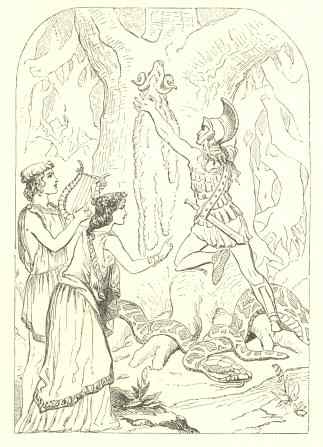
Then Jason leapt forward warily, and stept across that mightysnake, and tore the fleece from off the tree-trunk; and the fourrushed down the garden, to the bank where the Argolay.
There was a silence for a moment, while Jason held the goldenfleece on high. Then he cried, ‘Go now, goodArgo, swift and steady, if ever you would see Pelionmore.’
And she went, as the heroes drove her, grim and silent all,with muffled oars, till the pine-wood bent like willow in theirhands, and stout Argogroaned beneath their strokes.
On and on, beneath the dewy darkness, they fled swiftly downthe swirling stream; underneath black walls, and temples, and thecastles of the princes of the East; past sluice-mouths, andfragrant gardens, and groves of all strange fruits; past marsheswhere fat kine lay sleeping, and long beds of whispering reeds;till they heard the merry music of the surge upon the bar, as ittumbled in the moonlight all alone.
Into the surge they rushed, and Argoleapt the breakerslike a horse; for she knew the time was come to show her mettle,and win honour for the heroes and herself.
Into the surge they rushed, and Argoleapt the breakerslike a horse, till the heroes stopped all panting, each man uponhis oar, as she slid into the still broad sea.
Then Orpheus took his harp and sang a pæan, till theheroes’ hearts rose high again; and they rowed on stoutlyand steadfastly, away into the darkness of the West.
p. 127PART V
HOW THE ARGONAUTS WERE DRIVEN INTO THE UNKNOWN SEA
So they fled away in haste to the westward; but Aietes mannedhis fleet and followed them. And Lynceus the quick-eyed sawhim coming, while he was still many a mile away, and cried,‘I see a hundred ships, like a flock of white swans, far inthe east.’ And at that they rowed hard, like heroes;but the ships came nearer every hour.
Then Medeia, the dark witch-maiden, laid a cruel and a cunningplot; for she killed Absyrtus her young brother, and cast himinto the sea, and said, ‘Ere my father can take up hiscorpse and bury it, he must wait long, and be left farbehind.’
And all the heroes shuddered, and looked one at the other forshame; yet they did not punish that dark witch-woman, because shehad won for them the golden fleece.
And when Aietes came to the place he saw the floating corpse;and he stopped a long while, and bewailed his son, and took himup, and went home. But he sent on his sailors toward thewestward, and bound them by a mighty curse—‘Bringback to me that dark witch-woman, that she may die a dreadfuldeath. But if you return without her, you shall die by thesame death yourselves.’
So the Argonauts escaped for that time: but Father Zeus sawthat foul crime; and out of the heavens he sent a storm, andswept the ship far from her course. Day after day the stormdrove her, amid foam and blinding mist, till they knew no longerwhere they were, for the sun was blotted from the skies. And at last the ship struck on a shoal, amid low isles of mud andsand, and the waves rolled over her and through her, and theheroes lost all hope of life.
Then Jason cried to Hera, ‘Fair queen, who hastbefriended us till now, why hast thou left us in our misery, todie here among unknown seas? It is hard to lose the honourwhich we have won with such toil and danger, and hard never tosee Hellas again, and the pleasant bay of Pagasai.’
Then out and spoke the magic bough which stood upon theArgo’sbeak, ‘Because Father Zeus is angry,all this has fallen on you; for a cruel crime has been done onboard, and the sacred ship is foul with blood.’
At that some of the heroes cried, ‘Medeia is themurderess. Let the witch-woman bear her sin, anddie!’ And they seized Medeia, to hurl her into thesea, and atone for the young boy’s death; but the magicbough spoke again, ‘Let her live till her crimes arefull. Vengeance waits for her, slow and sure; but she mustlive, for you need her still. She must show you the way toher sister Circe, who lives among the islands of the West. To her you must sail, a weary way, and she shall cleanse you fromyour guilt.’
Then all the heroes wept aloud when they heard the sentence ofthe oak; for they knew that a dark journey lay before them, andyears of bitter toil. And some upbraided the darkwitch-woman, and some said, ‘Nay, we are her debtors still;without her we should never have won the fleece.’ Butmost of them bit their lips in silence, for they feared thewitch’s spells.
And now the sea grew calmer, and the sun shone out once more,and the heroes thrust the ship off the sand-bank, and rowedforward on their weary course under the guiding of the darkwitch-maiden, into the wastes of the unknown sea.
Whither they went I cannot tell, nor how they came toCirce’s isle. Some say that they went to thewestward, and up the Ister [130a] stream, and socame into the Adriatic, dragging their ship over the snowyAlps. And others say that they went southward, into the RedIndian Sea, and past the sunny lands where spices grow, roundÆthiopia toward the West; and that at last they came toLibya, and dragged their ship across the burning sands, and overthe hills into the Syrtes, where the flats and quicksands spreadfor many a mile, between rich Cyrene and the Lotus-eaters’shore. But all these are but dreams and fables, and dimhints of unknown lands.
But all say that they came to a place where they had to dragtheir ship across the land nine days with ropes and rollers, tillthey came into an unknown sea. And the best of all the oldsongs tells us how they went away toward the North, till theycame to the slope of Caucasus, where it sinks into the sea; andto the narrow Cimmerian Bosphorus, [130b] where the Titanswam across upon the bull; and thence into the lazy waters of thestill Mæotid lake. [130c] And thencethey went northward ever, up the Tanais, which we call Don, pastthe Geloni and Sauromatai, and many a wandering shepherd-tribe,and the one-eyed Arimaspi, of whom old Greek poets tell, whosteal the gold from the Griffins, in the cold Riphaian hills. [131a]
And they passed the Scythian archers, and the Tauri who eatmen, and the wandering Hyperboreai, who feed their flocks beneaththe pole-star, until they came into the northern ocean, the dulldead Cronian Sea. [131b] And thereArgowould move on no longer; and each man clasped hiselbow, and leaned his head upon his hand, heart-broken with toiland hunger, and gave himself up to death. But brave Ancaiosthe helmsman cheered up their hearts once more, and bade themleap on land, and haul the ship with ropes and rollers for many aweary day, whether over land, or mud, or ice, I know not, for thesong is mixed and broken like a dream. And it says next,how they came to the rich nation of the famous long-lived men;and to the coast of the Cimmerians, who never saw the sun, burieddeep in the glens of the snow mountains; and to the fair land ofHermione, where dwelt the most righteous of all nations; and tothe gates of the world below, and to the dwelling-place ofdreams.
And at last Ancaios shouted, ‘Endure a little while,brave friends, the worst is surely past; for I can see the purewest wind ruffle the water, and hear the roar of ocean on thesands. So raise up the mast, and set the sail, and facewhat comes like men.’
Then out spoke the magic bough, ‘Ah, would that I hadperished long ago, and been whelmed by the dread blue rocks,beneath the fierce swell of the Euxine! Better so, than towander for ever, disgraced by the guilt of my princes; for theblood of Absyrtus still tracks me, and woe follows hard uponwoe. And now some dark horror will clutch me, if I comenear the Isle of Ierne. [132] Unless youwill cling to the land, and sail southward and southward forever, I shall wander beyond the Atlantic, to the ocean which hasno shore.’
Then they blest the magic bough, and sailed southward alongthe land. But ere they could pass Ierne, the land of mistsand storms, the wild wind came down, dark and roaring, and caughtthe sail, and strained the ropes. And away they drovetwelve nights, on the wide wild western sea, through the foam,and over the rollers, while they saw neither sun nor stars. And they cried again, ‘We shall perish, for we know notwhere we are. We are lost in the dreary damp darkness, andcannot tell north from south.’
But Lynceus the long-sighted called gaily from the bows,‘Take heart again, brave sailors; for I see a pine-cladisle, and the halls of the kind Earth-mother, with a crown ofclouds around them.’
But Orpheus said, ‘Turn from them, for no living man canland there: there is no harbour on the coast, but steep-walledcliffs all round.’
So Ancaios turned the ship away; and for three days more theysailed on, till they came to Aiaia, Circe’s home, and thefairy island of the West. [133]
And there Jason bid them land, and seek about for any sign ofliving man. And as they went inland Circe met them, comingdown toward the ship; and they trembled when they saw her, forher hair, and face, and robes shone like flame.
And she came and looked at Medeia; and Medeia hid her facebeneath her veil.
And Circe cried, ‘Ah, wretched girl, have you forgottenall your sins, that you come hither to my island, where theflowers bloom all the year round? Where is your agedfather, and the brother whom you killed? Little do I expectyou to return in safety with these strangers whom you love. I will send you food and wine: but your ship must not stay here,for it is foul with sin, and foul with sin its crew.’
And the heroes prayed her, but in vain, and cried,‘Cleanse us from our guilt!’ But she sent them away,and said, ‘Go on to Malea, and there you may be cleansed,and return home.’
Then a fair wind rose, and they sailed eastward by Tartessuson the Iberian shore, till they came to the Pillars of Hercules,and the Mediterranean Sea. And thence they sailed onthrough the deeps of Sardinia, and past the Ausonian islands, andthe capes of the Tyrrhenian shore, till they came to a floweryisland, upon a still bright summer’s eve. And as theyneared it, slowly and wearily, they heard sweet songs upon theshore. But when Medeia heard it, she started, and cried,‘Beware, all heroes, for these are the rocks of theSirens. You must pass close by them, for there is no otherchannel; but those who listen to that song are lost.’
Then Orpheus spoke, the king of all minstrels, ‘Let themmatch their song against mine. I have charmed stones, andtrees, and dragons, how much more the hearts of men!’ So he caught up his lyre, and stood upon the poop, and began hismagic song.
And now they could see the Sirens on Anthemousa, the floweryisle; three fair maidens sitting on the beach, beneath a red rockin the setting sun, among beds of crimson poppies and goldenasphodel. Slowly they sung and sleepily, with silvervoices, mild and clear, which stole over the golden waters, andinto the hearts of all the heroes, in spite of Orpheus’song.
And all things stayed around and listened; the gulls sat inwhite lines along the rocks; on the beach great seals laybasking, and kept time with lazy heads; while silver shoals offish came up to hearken, and whispered as they broke the shiningcalm. The Wind overhead hushed his whistling, as heshepherded his clouds toward the west; and the clouds stood inmid blue, and listened dreaming, like a flock of goldensheep.
And as the heroes listened, the oars fell from their hands,and their heads drooped on their breasts, and they closed theirheavy eyes; and they dreamed of bright still gardens, and ofslumbers under murmuring pines, till all their toil seemedfoolishness, and they thought of their renown no more.
Then one lifted his head suddenly, and cried, ‘What usein wandering for ever? Let us stay here and restawhile.’ And another, ‘Let us row to the shore,and hear the words they sing.’ And another, ‘Icare not for the words, but for the music. They shall singme to sleep, that I may rest.’
And Butes, the son of Pandion, the fairest of all mortal men,leapt out and swam toward the shore, crying, ‘I come, Icome, fair maidens, to live and die here, listening to yoursong.’
Then Medeia clapped her hands together, and cried, ‘Singlouder, Orpheus, sing a bolder strain; wake up these haplesssluggards, or none of them will see the land of Hellasmore.’
Then Orpheus lifted his harp, and crashed his cunning handacross the strings; and his music and his voice rose like atrumpet through the still evening air; into the air it rushedlike thunder, till the rocks rang and the sea; and into theirsouls it rushed like wine, till all hearts beat fast within theirbreasts.
And he sung the song of Perseus, how the Gods led him overland and sea, and how he slew the loathly Gorgon, and won himselfa peerless bride; and how he sits now with the Gods upon Olympus,a shining star in the sky, immortal with his immortal bride, andhonoured by all men below.
So Orpheus sang, and the Sirens, answering each other acrossthe golden sea, till Orpheus’ voice drowned theSirens’, and the heroes caught their oars again.
And they cried, ‘We will be men like Perseus, and wewill dare and suffer to the last. Sing us his song again,brave Orpheus, that we may forget the Sirens and theirspell.’
And as Orpheus sang, they dashed their oars into the sea, andkept time to his music, as they fled fast away; and theSirens’ voices died behind them, in the hissing of the foamalong their wake.
But Butes swam to the shore, and knelt down before the Sirens,and cried, ‘Sing on! sing on!’ But he could sayno more, for a charmed sleep came over him, and a pleasanthumming in his ears; and he sank all along upon the pebbles, andforgot all heaven and earth, and never looked at that sad beacharound him, all strewn with the bones of men.
Then slowly rose up those three fair sisters, with a cruelsmile upon their lips; and slowly they crept down towards him,like leopards who creep upon their prey; and their hands werelike the talons of eagles as they stept across the bones of theirvictims to enjoy their cruel feast.
But fairest Aphrodite saw him from the highest Idalian peak,and she pitied his youth and his beauty, and leapt up from hergolden throne; and like a falling star she cleft the sky, andleft a trail of glittering light, till she stooped to the Isle ofthe Sirens, and snatched their prey from their claws. Andshe lifted Butes as he lay sleeping, and wrapt him in goldenmist; and she bore him to the peak of Lilybæum, and heslept there many a pleasant year.
But when the Sirens saw that they were conquered, theyshrieked for envy and rage, and leapt from the beach into thesea, and were changed into rocks until this day.
Then they came to the straits by Lilybæum, and sawSicily, the three-cornered island, under which Enceladus thegiant lies groaning day and night, and when he turns the earthquakes, and his breath bursts out in roaring flames from thehighest cone of Ætna, above the chestnut woods. Andthere Charybdis caught them in its fearful coils of wave, androlled mast-high about them, and spun them round and round; andthey could go neither back nor forward, while the whirlpoolsucked them in.
And while they struggled they saw near them, on the other sidethe strait, a rock stand in the water, with its peak wrapt roundin clouds—a rock which no man could climb, though he hadtwenty hands and feet, for the stone was smooth and slippery, asif polished by man’s hand; and halfway up a misty cavelooked out toward the west.
And when Orpheus saw it he groaned, and struck his handstogether. And ‘Little will it help us,’ hecried, ‘to escape the jaws of the whirlpool; for in thatcave lives Scylla, the sea-hag with a young whelp’s voice;my mother warned me of her ere we sailed away from Hellas; shehas six heads, and six long necks, and hides in that darkcleft. And from her cave she fishes for all things whichpass by—for sharks, and seals, and dolphins, and all theherds of Amphitrite. And never ship’s crew boastedthat they came safe by her rock, for she bends her long necksdown to them, and every mouth takes up a man. And who willhelp us now? For Hera and Zeus hate us, and our ship isfoul with guilt; so we must die, whatever befalls.’
Then out of the depths came Thetis, Peleus’silver-footed bride, for love of her gallant husband, and all hernymphs around her; and they played like snow-white dolphins,diving on from wave to wave, before the ship, and in her wake,and beside her, as dolphins play. And they caught the ship,and guided her, and passed her on from hand to hand, and tossedher through the billows, as maidens toss the ball. And whenScylla stooped to seize her, they struck back her ravening heads,and foul Scylla whined, as a whelp whines, at the touch of theirgentle hands. But she shrank into her caveaffrighted—for all bad things shrink from good—andArgoleapt safe past her, while a fair breeze rosebehind. Then Thetis and her nymphs sank down to their coralcaves beneath the sea, and their gardens of green and purple,where live flowers bloom all the year round; while the heroeswent on rejoicing, yet dreading what might come next.
After that they rowed on steadily for many a weary day, tillthey saw a long high island, and beyond it a mountain land. And they searched till they found a harbour, and there rowedboldly in. But after awhile they stopped, and wondered, forthere stood a great city on the shore, and temples and walls andgardens, and castles high in air upon the cliffs. And oneither side they saw a harbour, with a narrow mouth, but widewithin; and black ships without number, high and dry upon theshore.
Then Ancaios, the wise helmsman, spoke, ‘What new wonderis this? I know all isles, and harbours, and the windingsof all seas; and this should be Corcyra, where a few wildgoat-herds dwell. But whence come these new harbours andvast works of polished stone?’
But Jason said, ‘They can be no savage people. Wewill go in and take our chance.’
So they rowed into the harbour, among a thousand black-beakedships, each larger far than Argo, toward a quay ofpolished stone. And they wondered at that mighty city, withits roofs of burnished brass, and long and lofty walls of marble,with strong palisades above. And the quays were full ofpeople, merchants, and mariners, and slaves, going to and frowith merchandise among the crowd of ships. And theheroes’ hearts were humbled, and they looked at each otherand said, ‘We thought ourselves a gallant crew when wesailed from Iolcos by the sea; but how small we look before thiscity, like an ant before a hive of bees.’
Then the sailors hailed them roughly from the quay,‘What men are you?—we want no strangers here, norpirates. We keep our business to ourselves.’
But Jason answered gently, with many a flattering word, andpraised their city and their harbour, and their fleet of gallantships. ‘Surely you are the children of Poseidon, andthe masters of the sea; and we are but poor wandering mariners,worn out with thirst and toil. Give us but food and water,and we will go on our voyage in peace.’
Then the sailors laughed, and answered, ‘Stranger, youare no fool; you talk like an honest man, and you shall find ushonest too. We are the children of Poseidon, and themasters of the sea; but come ashore to us, and you shall have thebest that we can give.’
So they limped ashore, all stiff and weary, with long raggedbeards and sunburnt cheeks, and garments torn andweather-stained, and weapons rusted with the spray, while thesailors laughed at them (for they were rough-tongued, thoughtheir hearts were frank and kind). And one said,‘These fellows are but raw sailors; they look as if theyhad been sea-sick all the day.’ And another,‘Their legs have grown crooked with much rowing, till theywaddle in their walk like ducks.’
At that Idas the rash would have struck them; but Jason heldhim back, till one of the merchant kings spoke to them, a talland stately man.
‘Do not be angry, strangers; the sailor boys must havetheir jest. But we will treat you justly and kindly, forstrangers and poor men come from God; and you seem no commonsailors by your strength, and height, and weapons. Come upwith me to the palace of Alcinous, the rich sea-going king, andwe will feast you well and heartily; and after that you shalltell us your name.’
But Medeia hung back, and trembled, and whispered inJason’s ear, ‘We are betrayed, and are going to ourruin, for I see my countrymen among the crowd; dark-eyed Colchiin steel mail-shirts, such as they wear in my father’sland.’
‘It is too late to turn,’ said Jason. And hespoke to the merchant king, ‘What country is this, goodsir; and what is this new-built town?’
‘This is the land of the Phæaces, beloved by allthe Immortals; for they come hither and feast like friends withus, and sit by our side in the hall. Hither we came fromLiburnia to escape the unrighteous Cyclopes; for they robbed us,peaceful merchants, of our hard-earned wares and wealth. SoNausithous, the son of Poseidon, brought us hither, and died inpeace; and now his son Alcinous rules us, and Arete the wisest ofqueens.’
So they went up across the square, and wondered still more asthey went; for along the quays lay in order great cables, andyards, and masts, before the fair temple of Poseidon, theblue-haired king of the seas. And round the square workedthe ship-wrights, as many in number as ants, twining ropes, andhewing timber, and smoothing long yards and oars. And theMinuai went on in silence through clean white marble streets,till they came to the hall of Alcinous, and they wondered thenstill more. For the lofty palace shone aloft in the sun,with walls of plated brass, from the threshold to the innermostchamber, and the doors were of silver and gold. And on eachside of the doorway sat living dogs of gold, who never grew oldor died, so well Hephaistos had made them in his forges insmoking Lemnos, and gave them to Alcinous to guard his gates bynight. And within, against the walls, stood thrones oneither side, down the whole length of the hall, strewn with richglossy shawls; and on them the merchant kings of those craftysea-roving Phæaces sat eating and drinking in pride, andfeasting there all the year round. And boys of molten goldstood each on a polished altar, and held torches in their hands,to give light all night to the guests. And round the housesat fifty maid-servants, some grinding the meal in the mill, someturning the spindle, some weaving at the loom, while their handstwinkled as they passed the shuttle, like quivering aspenleaves.
And outside before the palace a great garden was walled round,filled full of stately fruit-trees, gray olives and sweet figs,and pomegranates, pears, and apples, which bore the whole yearround. For the rich south-west wind fed them, till peargrew ripe on pear, fig on fig, and grape on grape, all the winterand the spring. And at the farther end gay flower-bedsbloomed through all seasons of the year; and two fair fountainsrose, and ran, one through the garden grounds, and one beneaththe palace gate, to water all the town. Such noble giftsthe heavens had given to Alcinous the wise.
So they went in, and saw him sitting, like Poseidon, on histhrone, with his golden sceptre by him, in garments stiff withgold, and in his hand a sculptured goblet, as he pledged themerchant kings; and beside him stood Arete, his wise and lovelyqueen, and leaned against a pillar as she spun her goldenthreads.
Then Alcinous rose, and welcomed them, and bade them sit andeat; and the servants brought them tables, and bread, and meat,and wine.
But Medeia went on trembling toward Arete the fair queen, andfell at her knees, and clasped them, and cried, weeping, as sheknelt—
‘I am your guest, fair queen, and I entreat you by Zeus,from whom prayers come. Do not send me back to my father todie some dreadful death; but let me go my way, and bear myburden. Have I not had enough of punishment andshame?’
‘Who are you, strange maiden? and what is the meaning ofyour prayer?’
‘I am Medeia, daughter of Aietes, and I saw mycountrymen here to-day; and I know that they are come to find me,and take me home to die some dreadful death.’
Then Arete frowned, and said, ‘Lead this girl in, mymaidens; and let the kings decide, not I.’
And Alcinous leapt up from his throne, and cried,‘Speak, strangers, who are you? And who is thismaiden?’
‘We are the heroes of the Minuai,’ said Jason;‘and this maiden has spoken truth. We are the men whotook the golden fleece, the men whose fame has run round everyshore. We came hither out of the ocean, after sorrows suchas man never saw before. We went out many, and come backfew, for many a noble comrade have we lost. So let us go,as you should let your guests go, in peace; that the world maysay, “Alcinous is a just king.”’
But Alcinous frowned, and stood deep in thought; and at lasthe spoke—
‘Had not the deed been done which is done, I should havesaid this day to myself, “It is an honour to Alcinous, andto his children after him, that the far-famed Argonauts are hisguests.” But these Colchi are my guests, as you are;and for this month they have waited here with all their fleet,for they have hunted all the seas of Hellas, and could not findyou, and dared neither go farther, nor go home.’
‘Let them choose out their champions, and we will fightthem, man for man.’
‘No guests of ours shall fight upon our island, and ifyou go outside they will outnumber you. I will do justicebetween you, for I know and do what is right.’
Then he turned to his kings, and said, ‘This may standover till to-morrow. To-night we will feast our guests, andhear the story of all their wanderings, and how they came hitherout of the ocean.’
So Alcinous bade the servants take the heroes in, and bathethem, and give them clothes. And they were glad when theysaw the warm water, for it was long since they had bathed. And they washed off the sea-salt from their limbs, and anointedthemselves from head to foot with oil, and combed out theirgolden hair. Then they came back again into the hall, whilethe merchant kings rose up to do them honour. And each mansaid to his neighbour, ‘No wonder that these men wonfame. How they stand now like Giants, or Titans, orImmortals come down from Olympus, though many a winter has wornthem, and many a fearful storm. What must they have beenwhen they sailed from Iolcos, in the bloom of their youth, longago?’
Then they went out to the garden; and the merchant princessaid, ‘Heroes, run races with us. Let us see whosefeet are nimblest.’
‘We cannot race against you, for our limbs are stifffrom sea; and we have lost our two swift comrades, the sons ofthe north wind. But do not think us cowards: if you wish totry our strength, we will shoot, and box, and wrestle, againstany men on earth.’
And Alcinous smiled, and answered, ‘I believe you,gallant guests; with your long limbs and broad shoulders, wecould never match you here. For we care nothing here forboxing, or for shooting with the bow; but for feasts, and songs,and harping, and dancing, and running races, to stretch our limbson shore.’
So they danced there and ran races, the jolly merchant kings,till the night fell, and all went in.
And then they ate and drank, and comforted their weary souls,till Alcinous called a herald, and bade him go and fetch theharper.
The herald went out, and fetched the harper, and led him in bythe hand; and Alcinous cut him a piece of meat, from the fattestof the haunch, and sent it to him, and said, ‘Sing to us,noble harper, and rejoice the heroes’ hearts.’
So the harper played and sang, while the dancers dancedstrange figures; and after that the tumblers showed their tricks,till the heroes laughed again.
Then, ‘Tell me, heroes,’ asked Alcinous,‘you who have sailed the ocean round, and seen the mannersof all nations, have you seen such dancers as ours here, or heardsuch music and such singing? We hold ours to be the best onearth.’
‘Such dancing we have never seen,’ said Orpheus;‘and your singer is a happy man, for Phoebus himself musthave taught him, or else he is the son of a Muse, as I am also,and have sung once or twice, though not so well as he.’
‘Sing to us, then, noble stranger,’ said Alcinous;‘and we will give you precious gifts.’
So Orpheus took his magic harp, and sang to them a stirringsong of their voyage from Iolcos, and their dangers, and how theywon the golden fleece; and of Medeia’s love, and how shehelped them, and went with them over land and sea; and of alltheir fearful dangers, from monsters, and rocks, and storms, tillthe heart of Arete was softened, and all the women wept. And the merchant kings rose up, each man from off his goldenthrone, and clapped their hands, and shouted, ‘Hail to thenoble Argonauts, who sailed the unknown sea!’
Then he went on, and told their journey over the sluggishnorthern main, and through the shoreless outer ocean, to thefairy island of the west; and of the Sirens, and Scylla, andCharybdis, and all the wonders they had seen, till midnightpassed and the day dawned; but the kings never thought ofsleep. Each man sat still and listened, with his chin uponhis hand.
And at last, when Orpheus had ended, they all went thoughtfulout, and the heroes lay down to sleep, beneath the sounding porchoutside, where Arete had strewn them rugs and carpets, in thesweet still summer night.
But Arete pleaded hard with her husband for Medeia, for herheart was softened. And she said, ‘The Gods willpunish her, not we. After all, she is our guest and mysuppliant, and prayers are the daughters of Zeus. And who,too, dare part man and wife, after all they have enduredtogether?’
And Alcinous smiled. ‘The minstrel’s songhas charmed you: but I must remember what is right, for songscannot alter justice; and I must be faithful to my name. Alcinous I am called, the man of sturdy sense; and Alcinous Iwill be.’ But for all that Arete besought him, untilshe won him round.
So next morning he sent a herald, and called the kings intothe square, and said, ‘This is a puzzling matter: rememberbut one thing. These Minuai live close by us, and we maymeet them often on the seas; but Aietes lives afar off, and wehave only heard his name. Which, then, of the two is itsafer to offend—the men near us, or the men faroff?’
The princes laughed, and praised his wisdom; and Alcinouscalled the heroes to the square, and the Colchi also; and theycame and stood opposite each other, but Medeia stayed in thepalace. Then Alcinous spoke, ‘Heroes of the Colchi,what is your errand about this lady?’
‘To carry her home with us, that she may die a shamefuldeath; but if we return without her, we must die the death sheshould have died.’
‘What say you to this, Jason the Æolid?’said Alcinous, turning to the Minuai.
‘I say,’ said the cunning Jason, ‘that theyare come here on a bootless errand. Do you think that youcan make her follow you, heroes of the Colchi—her, whoknows all spells and charms? She will cast away your shipson quicksands, or call down on you Brimo the wild huntress; orthe chains will fall from off her wrists, and she will escape inher dragon-car; or if not thus, some other way, for she has athousand plans and wiles. And why return home at all, braveheroes, and face the long seas again, and the Bosphorus, and thestormy Euxine, and double all your toil? There is many afair land round these coasts, which waits for gallant men likeyou. Better to settle there, and build a city, and letAietes and Colchis help themselves.’
Then a murmur rose among the Colchi, and some cried ‘Hehas spoken well;’ and some, ‘We have had enough ofroving, we will sail the seas no more!’ And the chiefsaid at last, ‘Be it so, then; a plague she has been to us,and a plague to the house of her father, and a plague she will beto you. Take her, since you are no wiser; and we will sailaway toward the north.’
Then Alcinous gave them food, and water, and garments, andrich presents of all sorts; and he gave the same to the Minuai,and sent them all away in peace.
So Jason kept the dark witch-maiden to breed him woe andshame; and the Colchi went northward into the Adriatic, andsettled, and built towns along the shore.
Then the heroes rowed away to the eastward, to reach Hellas,their beloved land; but a storm came down upon them, and sweptthem far away toward the south. And they rowed till theywere spent with struggling, through the darkness and the blindingrain; but where they were they could not tell, and they gave upall hope of life. And at last touched the ground, and whendaylight came waded to the shore; and saw nothing round but sandand desolate salt pools, for they had come to the quicksands ofthe Syrtis, and the dreary treeless flats which lie betweenNumidia and Cyrene, on the burning shore of Africa. Andthere they wandered starving for many a weary day, ere they couldlaunch their ship again, and gain the open sea. And thereCanthus was killed, while he was trying to drive off sheep, by astone which a herdsman threw.
And there too Mopsus died, the seer who knew the voices of allbirds; but he could not foretell his own end, for he was bittenin the foot by a snake, one of those which sprang from theGorgon’s head when Perseus carried it across the sands.
At last they rowed away toward the northward, for many a wearyday, till their water was spent, and their food eaten; and theywere worn out with hunger and thirst. But at last they sawa long steep island, and a blue peak high among the clouds; andthey knew it for the peak of Ida, and the famous land ofCrete. And they said, ‘We will land in Crete, and seeMinos the just king, and all his glory and his wealth; at leasthe will treat us hospitably, and let us fill our water-casks uponthe shore.’
But when they came nearer to the island they saw a wondroussight upon the cliffs. For on a cape to the westward stooda giant, taller than any mountain pine, who glittered aloftagainst the sky like a tower of burnished brass. He turnedand looked on all sides round him, till he saw the Argoand her crew; and when he saw them he came toward them, moreswiftly than the swiftest horse, leaping across the glens at abound, and striding at one step from down to down. And whenhe came abreast of them he brandished his arms up and down, as aship hoists and lowers her yards, and shouted with his brazenthroat like a trumpet from off the hills, ‘You are pirates,you are robbers! If you dare land here, you die.’
Then the heroes cried, ‘We are no pirates. We areall good men and true, and all we ask is food and water;’but the giant cried the more—
‘You are robbers, you are pirates all; I know you; andif you land, you shall die the death.’
Then he waved his arms again as a signal, and they saw thepeople flying inland, driving their flocks before them, while agreat flame arose among the hills. Then the giant ran up avalley and vanished, and the heroes lay on their oars infear.
But Medeia stood watching all from under her steep blackbrows, with a cunning smile upon her lips, and a cunning plotwithin her heart. At last she spoke, ‘I know thisgiant. I heard of him in the East. Hephaistos theFire King made him in his forge in Ætna beneath the earth,and called him Talus, and gave him to Minos for a servant, toguard the coast of Crete. Thrice a day he walks round theisland, and never stops to sleep; and if strangers land he leapsinto his furnace, which flames there among the hills; and when heis red-hot he rushes on them, and burns them in his brazenhands.’
Then all the heroes cried, ‘What shall we do, wiseMedeia? We must have water, or we die of thirst. Flesh and blood we can face fairly; but who can face this red-hotbrass?’
‘I can face red-hot brass, if the tale I hear betrue. For they say that he has but one vein in all hisbody, filled with liquid fire; and that this vein is closed witha nail: but I know not where that nail is placed. But if Ican get it once into these hands, you shall water your ship herein peace.’
Then she bade them put her on shore, and row off again, andwait what would befall.
And the heroes obeyed her unwillingly, for they were ashamedto leave her so alone; but Jason said, ‘She is dearer to methan to any of you, yet I will trust her freely on shore; she hasmore plots than we can dream of in the windings of that fair andcunning head.’
So they left the witch-maiden on the shore; and she stoodthere in her beauty all alone, till the giant strode back red-hotfrom head to heel, while the grass hissed and smoked beneath histread.
And when he saw the maiden alone, he stopped; and she lookedboldly up into his face without moving, and began her magicsong:—
‘Life is short, though life is sweet; and even men ofbrass and fire must die. The brass must rust, the fire mustcool, for time gnaws all things in their turn. Life isshort, though life is sweet: but sweeter to live for ever;sweeter to live ever youthful like the Gods, who have ichor intheir veins—ichor which gives life, and youth, and joy, anda bounding heart.’
Then Talus said, ‘Who are you, strange maiden, and whereis this ichor of youth?’
Then Medeia held up a flask of crystal, and said, ‘Hereis the ichor of youth. I am Medeia the enchantress; mysister Circe gave me this, and said, “Go and reward Talus,the faithful servant, for his fame is gone out into alllands.” So come, and I will pour this into yourveins, that you may live for ever young.’
And he listened to her false words, that simple Talus, andcame near; and Medeia said, ‘Dip yourself in the sea first,and cool yourself, lest you burn my tender hands; then show mewhere the nail in your vein is, that I may pour the ichorin.’
Then that simple Talus dipped himself in the sea, till ithissed, and roared, and smoked; and came and knelt before Medeia,and showed her the secret nail.
And she drew the nail out gently, but she poured no ichor in;and instead the liquid fire spouted forth, like a stream ofred-hot iron. And Talus tried to leap up, crying,‘You have betrayed me, false witch-maiden!’ Butshe lifted up her hands before him, and sang, till he sankbeneath her spell. And as he sank, his brazen limbs clankedheavily, and the earth groaned beneath his weight; and the liquidfire ran from his heel, like a stream of lava, to the sea; andMedeia laughed, and called to the heroes, ‘Come ashore, andwater your ship in peace.’
So they came, and found the giant lying dead; and they felldown, and kissed Medeia’s feet; and watered their ship, andtook sheep and oxen, and so left that inhospitable shore.
At last, after many more adventures, they came to the Cape ofMalea, at the south-west point of the Peloponnese. Andthere they offered sacrifices, and Orpheus purged them from theirguilt. Then they rode away again to the northward, past theLaconian shore, and came all worn and tired by Sunium, and up thelong Euboean Strait, until they saw once more Pelion, andAphetai, and Iolcos by the sea.
And they ran the ship ashore; but they had no strength left tohaul her up the beach; and they crawled out on the pebbles, andsat down, and wept till they could weep no more. For thehouses and the trees were all altered; and all the faces whichthey saw were strange; and their joy was swallowed up in sorrow,while they thought of their youth, and all their labour, and thegallant comrades they had lost.
And the people crowded round, and asked them ‘Who areyou, that you sit weeping here?’
‘We are the sons of your princes, who sailed out many ayear ago. We went to fetch the golden fleece, and we havebrought it, and grief therewith. Give us news of ourfathers and our mothers, if any of them be left alive onearth.’
Then there was shouting, and laughing, and weeping; and allthe kings came to the shore, and they led away the heroes totheir homes, and bewailed the valiant dead.
Then Jason went up with Medeia to the palace of his unclePelias. And when he came in Pelias sat by the hearth,crippled and blind with age; while opposite him sat Æson,Jason’s father, crippled and blind likewise; and the twoold men’s heads shook together as they tried to warmthemselves before the fire.
And Jason fell down at his father’s knees, and wept, andcalled him by his name. And the old man stretched his handsout, and felt him, and said, ‘Do not mock me, younghero. My son Jason is dead long ago at sea.’
‘I am your own son Jason, whom you trusted to theCentaur upon Pelion; and I have brought home the golden fleece,and a princess of the Sun’s race for my bride. So nowgive me up the kingdom, Pelias my uncle, and fulfil your promiseas I have fulfilled mine.’
Then his father clung to him like a child, and wept, and wouldnot let him go; and cried, ‘Now I shall not go down lonelyto my grave. Promise me never to leave me till Idie.’
p. 161PART VI
WHAT WAS THE END OF THE HEROES
And now I wish that I could end my story pleasantly; but it isno fault of mine that I cannot. The old songs end it sadly,and I believe that they are right and wise; for though the heroeswere purified at Malea, yet sacrifices cannot make bad heartsgood, and Jason had taken a wicked wife, and he had to bear hisburden to the last.
And first she laid a cunning plot to punish that poor oldPelias, instead of letting him die in peace.
For she told his daughters, ‘I can make old things youngagain; I will show you how easy it is to do.’ So shetook an old ram and killed him, and put him in a cauldron withmagic herbs; and whispered her spells over him, and he leapt outagain a young lamb. So that ‘Medeia’scauldron’ is a proverb still, by which we mean times of warand change, when the world has become old and feeble, and growsyoung again through bitter pains.
Then she said to Pelias’ daughters, ‘Do to yourfather as I did to this ram, and he will grow young and strongagain.’ But she only told them half the spell; sothey failed, while Medeia mocked them; and poor old Pelias died,and his daughters came to misery. But the songs say shecured Æson, Jason’s father, and he became young, andstrong again.
But Jason could not love her, after all her cruel deeds. So he was ungrateful to her, and wronged her; and she revengedherself on him. And a terrible revenge she took—tooterrible to speak of here. But you will hear of ityourselves when you grow up, for it has been sung in noble poetryand music; and whether it be true or not, it stands for ever as awarning to us not to seek for help from evil persons, or to gaingood ends by evil means. For if we use an adder evenagainst our enemies, it will turn again and sting us.
But of all the other heroes there is many a brave tale left,which I have no space to tell you, so you must read them foryourselves;—of the hunting of the boar in Calydon, whichMeleager killed; and of Heracles’ twelve famous labours;and of the seven who fought at Thebes; and of the noble love ofCastor and Polydeuces, the twin Dioscouroi—how when onedied the other would not live without him, so they shared theirimmortality between them; and Zeus changed them into the two twinstars which never rise both at once.
And what became of Cheiron, the good immortal beast? That, too, is a sad story; for the heroes never saw himmore. He was wounded by a poisoned arrow, at Pholoe amongthe hills, when Heracles opened the fatal wine-jar, which Cheironhad warned him not to touch. And the Centaurs smelt thewine, and flocked to it, and fought for it with Heracles; but hekilled them all with his poisoned arrows, and Cheiron was leftalone. Then Cheiron took up one of the arrows, and droppedit by chance upon his foot; and the poison ran like fire alonghis veins, and he lay down and longed to die; and cried,‘Through wine I perish, the bane of all my race. Whyshould I live for ever in this agony? Who will take myimmortality, that I may die?’
Then Prometheus answered, the good Titan, whom Heracles hadset free from Caucasus, ‘I will take your immortality andlive for ever, that I may help poor mortal men.’ SoCheiron gave him his immortality, and died, and had rest frompain. And Heracles and Prometheus wept over him, and wentto bury him on Pelion; but Zeus took him up among the stars, tolive for ever, grand and mild, low down in the far southernsky.
And in time the heroes died, all but Nestor, thesilver-tongued old man; and left behind them valiant sons, butnot so great as they had been. Yet their fame, too, livestill this day, for they fought at the ten years’ siege ofTroy: and their story is in the book which we call Homer, in twoof the noblest songs on earth—the ‘Iliad,’which tells us of the siege of Troy, and Achilles’ quarrelwith the kings; and the ‘Odyssey,’ which tells thewanderings of Odysseus, through many lands for many years, andhow Alcinous sent him home at last, safe to Ithaca his belovedisland, and to Penelope his faithful wife, and Telemachus hisson, and Euphorbus the noble swineherd, and the old dog wholicked his hand and died. We will read that sweet story,children, by the fire some winter night. And now I will endmy tale, and begin another and a more cheerful one, of a hero whobecame a worthy king, and won his people’s love.
p. 165STORY III.—THESEUS
PART I
HOW THESEUS LIFTED THE STONE
Once upon a time there was a princess in Trœzene,Aithra, the daughter of Pittheus the king. She had one fairson, named Theseus, the bravest lad in all the land; and Aithranever smiled but when she looked at him, for her husband hadforgotten her, and lived far away. And she used to go up tothe mountain above Troezene, to the temple of Poseidon and sitthere all day looking out across the bay, over Methana, to thepurple peaks of Ægina and the Attic shore beyond. Andwhen Theseus was full fifteen years old she took him up with herto the temple, and into the thickets of the grove which grew inthe temple-yard. And she led him to a tall plane-tree,beneath whose shade grew arbutus, and lentisk, and purpleheather-bushes. And there she sighed, and said,‘Theseus, my son, go into that thicket and you will find atthe plane-tree foot a great flat stone; lift it, and bring mewhat lies underneath.’
Then Theseus pushed his way in through the thick bushes, andsaw that they had not been moved for many a year. Andsearching among their roots he found a great flat stone, allovergrown with ivy, and acanthus, and moss. He tried tolift it, but he could not. And he tried till the sweat randown his brow from heat, and the tears from his eyes for shame;but all was of no avail. And at last he came back to hismother, and said, ‘I have found the stone, but I cannotlift it; nor do I think that any man could in allTroezene.’
Then she sighed, and said, ‘The Gods wait long; but theyare just at last. Let it be for another year. The daymay come when you will be a stronger man than lives in allTroezene.’
Then she took him by the hand, and went into the temple andprayed, and came down again with Theseus to her home.
And when a full year was past she led Theseus up again to thetemple, and bade him lift the stone; but he could not.
Then she sighed, and said the same words again, and went down,and came again the next year; but Theseus could not lift thestone then, nor the year after; and he longed to ask his motherthe meaning of that stone, and what might lie underneath it; buther face was so sad that he had not the heart to ask.
So he said to himself, ‘The day shall surely come when Iwill lift that stone, though no man in Troezene can.’ And in order to grow strong he spent all his days in wrestling,and boxing, and hurling, and taming horses, and hunting the boarand the bull, and coursing goats and deer among the rocks; tillupon all the mountains there was no hunter so swift as Theseus;and he killed Phaia the wild sow of Crommyon, which wasted allthe land; till all the people said, ‘Surely the Gods arewith the lad.’
And when his eighteenth year was past, Aithra led him up againto the temple, and said, ‘Theseus, lift the stone this day,or never know who you are.’ And Theseus went into thethicket, and stood over the stone, and tugged at it; and itmoved. Then his spirit swelled within him, and he said,‘If I break my heart in my body, it shall up.’ And he tugged at it once more, and lifted it, and rolled it overwith a shout.
And when he looked beneath it, on the ground lay a sword ofbronze, with a hilt of glittering gold, and by it a pair ofgolden sandals; and he caught them up, and burst through thebushes like a wild boar, and leapt to his mother, holding themhigh above his head.
But when she saw them she wept long in silence, hiding herfair face in her shawl; and Theseus stood by her wondering, andwept also, he knew not why. And when she was tired ofweeping, she lifted up her head, and laid her finger on her lips,and said, ‘Hide them in your bosom, Theseus my son, andcome with me where we can look down upon the sea.’
Then they went outside the sacred wall, and looked down overthe bright blue sea; and Aithra said—
‘Do you see this land at our feet?’
And he said, ‘Yes; this is Troezene, where I was bornand bred.’
And she said, ‘It is but a little land, barren androcky, and looks towards the bleak north-east. Do you seethat land beyond?’
‘Yes; that is Attica, where the Athenian peopledwell.’
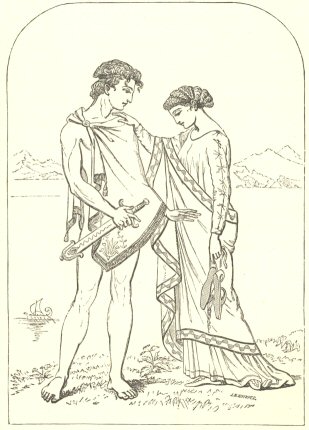
‘That is a fair land and large, Theseus my son; and itlooks toward the sunny south; a land of olive-oil and honey, thejoy of Gods and men. For the Gods have girdled it withmountains, whose veins are of pure silver, and their bones ofmarble white as snow; and there the hills are sweet with thymeand basil, and the meadows with violet and asphodel, and thenightingales sing all day in the thickets, by the side ofever-flowing streams. There are twelve towns well peopled,the homes of an ancient race, the children of Kekrops the serpentking, the son of Mother Earth, who wear gold cicalas among thetresses of their golden hair; for like the cicalas they sprangfrom the earth, and like the cicalas they sing all day, rejoicingin the genial sun. What would you do, son Theseus, if youwere king of such a land?’
Then Theseus stood astonished, as he looked across the broadbright sea, and saw the fair Attic shore, from Sunium to Hymettusand Pentelicus, and all the mountain peaks which girdle Athensround. But Athens itself he could not see, for purpleÆgina stood before it, midway across the sea.
Then his heart grew great within him, and he said, ‘If Iwere king of such a land I would rule it wisely and well inwisdom and in might, that when I died all men might weep over mytomb, and cry, “Alas for the shepherd of hispeople!”’
And Aithra smiled, and said, ‘Take, then, the sword andthe sandals, and go to Ægeus, king of Athens, who lives onPallas’ hill; and say to him, “The stone is lifted,but whose is the pledge beneath it?” Then show himthe sword and the sandals, and take what the Gods shallsend.’
But Theseus wept, ‘Shall I leave you, O mymother?’
But she answered, ‘Weep not for me. That which isfated must be; and grief is easy to those who do nought butgrieve. Full of sorrow was my youth, and full of sorrow mywomanhood. Full of sorrow was my youth for Bellerophon, theslayer of the Chimæra, whom my father drove away bytreason; and full of sorrow my womanhood, for thy treacherousfather and for thee; and full of sorrow my old age will be (for Isee my fate in dreams), when the sons of the Swan shall carry mecaptive to the hollow vale of Eurotas, till I sail across theseas a slave, the handmaid of the pest of Greece. Yet shallI be avenged, when the golden-haired heroes sail against Troy,and sack the palaces of Ilium; then my son shall set me free fromthraldom, and I shall hear the tale of Theseus’ fame. Yet beyond that I see new sorrows; but I can bear them as I haveborne the past.’
Then she kissed Theseus, and wept over him; and went into thetemple, and Theseus saw her no more.
p. 172PART II
HOW THESEUS SLEW THE DEVOURERS OF MEN
So Theseus stood there alone, with his mind full of manyhopes. And first he thought of going down to the harbourand hiring a swift ship, and sailing across the bay to Athens;but even that seemed too slow for him, and he longed for wings tofly across the sea, and find his father. But after a whilehis heart began to fail him; and he sighed, and said withinhimself—
‘What if my father have other sons about him whom heloves? What if he will not receive me? And what haveI done that he should receive me? He has forgotten me eversince I was born: why should he welcome me now?’
Then he thought a long while sadly; and at the last he criedaloud, ‘Yes! I will make him love me; for I willprove myself worthy of his love. I will win honour andrenown, and do such deeds that Ægeus shall be proud of me,though he had fifty other sons! Did not Heracles winhimself honour, though he was opprest, and the slave ofEurystheus? Did he not kill all robbers and evil beasts,and drain great lakes and marshes, breaking the hills throughwith his club? Therefore it was that all men honoured him,because he rid them of their miseries, and made life pleasant tothem and their children after them. Where can I go, to doas Heracles has done? Where can I find strange adventures,robbers, and monsters, and the children of hell, the enemies ofmen? I will go by land, and into the mountains, and roundby the way of the Isthmus. Perhaps there I may hear ofbrave adventures, and do something which shall win myfather’s love.’
So he went by land, and away into the mountains, with hisfather’s sword upon his thigh, till he came to the Spidermountains, which hang over Epidaurus and the sea, where the glensrun downward from one peak in the midst, as the rays spread inthe spider’s web.
And he went up into the gloomy glens, between the furrowedmarble walls, till the lowland grew blue beneath his feet and theclouds drove damp about his head.
But he went up and up for ever, through the spider’s webof glens, till he could see the narrow gulfs spread below him,north and south, and east and west; black cracks half-choked withmists, and above all a dreary down.
But over that down he must go, for there was no road right orleft; so he toiled on through bog and brake, till he came to apile of stones.
And on the stones a man was sitting, wrapt in a bearskincloak. The head of the bear served him for a cap, and itsteeth grinned white around his brows; and the feet were tiedabout his throat, and their claws shone white upon hischest. And when he saw Theseus he rose, and laughed tillthe glens rattled.
‘And who art thou, fair fly, who hast walked into thespider’s web?’ But Theseus walked on steadily,and made no answer; but he thought, ‘Is this some robber?and has an adventure come already to me?’ But thestrange man laughed louder than ever, and said—
‘Bold fly, know you not that these glens are the webfrom which no fly ever finds his way out again, and this down thespider’s house, and I the spider who sucks the flies? Come hither, and let me feast upon you; for it is of no use torun away, so cunning a web has my father Hephaistos spread for mewhen he made these clefts in the mountains, through which no manfinds his way home.’
But Theseus came on steadily, and asked—
‘And what is your name among men, bold spider? and whereare your spider’s fangs?’
Then the strange man laughed again—
‘My name is Periphetes, the son of Hephaistos andAnticleia the mountain nymph. But men call me Corynetes theclub-bearer; and here is my spider’s fang.’
And he lifted from off the stones at his side a mighty club ofbronze.
‘This my father gave me, and forged it himself in theroots of the mountain; and with it I pound all proud flies tillthey give out their fatness and their sweetness. So give meup that gay sword of yours, and your mantle, and your goldensandals, lest I pound you, and by ill-luck you die.’
But Theseus wrapt his mantle round his left arm quickly, inhard folds, from his shoulder to his hand, and drew his sword,and rushed upon the club-bearer, and the club-bearer rushed onhim.
Thrice he struck at Theseus, and made him bend under the blowslike a sapling; but Theseus guarded his head with his left arm,and the mantle which was wrapt around it.
And thrice Theseus sprang upright after the blow, like asapling when the storm is past; and he stabbed at the club-bearerwith his sword, but the loose folds of the bearskin savedhim.
Then Theseus grew mad, and closed with him, and caught him bythe throat, and they fell and rolled over together; but whenTheseus rose up from the ground the club-bearer lay still at hisfeet.
Then Theseus took his club and his bearskin, and left him tothe kites and crows, and went upon his journey down the glens onthe farther slope, till he came to a broad green valley, and sawflocks and herds sleeping beneath the trees.
And by the side of a pleasant fountain, under the shade ofrocks and trees, were nymphs and shepherds dancing; but no onepiped to them while they danced.
And when they saw Theseus they shrieked; and the shepherds ranoff, and drove away their flocks, while the nymphs dived into thefountain like coots, and vanished.
Theseus wondered and laughed: ‘What strange fancies havefolks here who run away from strangers, and have no music whenthey dance!’ But he was tired, and dusty, andthirsty; so he thought no more of them, but drank and bathed inthe clear pool, and then lay down in the shade under aplane-tree, while the water sang him to sleep, as it tinkled downfrom stone to stone.
And when he woke he heard a whispering, and saw the nymphspeeping at him across the fountain from the dark mouth of a cave,where they sat on green cushions of moss. And one said,‘Surely he is not Periphetes;’ and another, ‘Helooks like no robber, but a fair and gentle youth.’
Then Theseus smiled, and called them, ‘Fair nymphs, I amnot Periphetes. He sleeps among the kites and crows; but Ihave brought away his bearskin and his club.’
Then they leapt across the pool, and came to him, and calledthe shepherds back. And he told them how he had slain theclub-bearer: and the shepherds kissed his feet and sang,‘Now we shall feed our flocks in peace, and not be afraidto have music when we dance; for the cruel club-bearer has methis match, and he will listen for our pipes no more.’ Then they brought him kid’s flesh and wine, and the nymphsbrought him honey from the rocks, and he ate, and drank, andslept again, while the nymphs and shepherds danced andsang. And when he woke, they begged him to stay; but hewould not. ‘I have a great work to do,’ hesaid; ‘I must be away toward the Isthmus, that I may go toAthens.’
But the shepherds said, ‘Will you go alone towardAthens? None travel that way now, except in armedtroops.’
‘As for arms, I have enough, as you see. And asfor troops, an honest man is good enough company forhimself. Why should I not go alone towardAthens?’
‘If you do, you must look warily about you on theIsthmus, lest you meet Sinis the robber, whom men callPituocamptes the pine-bender; for he bends down two pine-trees,and binds all travellers hand and foot between them, and when helets the trees go again their bodies are torn insunder.’
‘And after that,’ said another, ‘you must goinland, and not dare to pass over the cliffs of Sciron; for onthe left hand are the mountains, and on the right the sea, sothat you have no escape, but must needs meet Sciron the robber,who will make you wash his feet; and while you are washing themhe will kick you over the cliff, to the tortoise who lives below,and feeds upon the bodies of the dead.’
And before Theseus could answer, another cried, ‘Andafter that is a worse danger still, unless you go inland always,and leave Eleusis far on your right. For in Eleusis rulesKerkuon the cruel king, the terror of all mortals, who killed hisown daughter Alope in prison. But she was changed into afair fountain; and her child he cast out upon the mountains, butthe wild mares gave it milk. And now he challenges allcomers to wrestle with him, for he is the best wrestler in allAttica, and overthrows all who come; and those whom he overthrowshe murders miserably, and his palace-court is full of theirbones.’
Then Theseus frowned, and said, ‘This seems indeed anill-ruled land, and adventures enough in it to be tried. But if I am the heir of it, I will rule it and right it, and hereis my royal sceptre.’
And he shook his club of bronze, while the nymphs andshepherds clung round him, and entreated him not to go.
But on he went nevertheless, till he could see both the seasand the citadel of Corinth towering high above all theland. And he past swiftly along the Isthmus, for his heartburned to meet that cruel Sinis; and in a pine-wood at last hemet him, where the Isthmus was narrowest and the road ran betweenhigh rocks. There he sat upon a stone by the wayside, witha young fir-tree for a club across his knees, and a cord laidready by his side; and over his head, upon the fir-tops, hung thebones of murdered men.
Then Theseus shouted to him, ‘Holla, thou valiantpine-bender, hast thou two fir-trees left for me?’
And Sinis leapt to his feet, and answered, pointing to thebones above his head, ‘My larder has grown empty lately, soI have two fir-trees ready for thee.’ And he rushedon Theseus, lifting his club, and Theseus rushed upon him.
Then they hammered together till the greenwoods rang; but themetal was tougher than the pine, and Sinis’ club brokeright across, as the bronze came down upon it. Then Theseusheaved up another mighty stroke, and smote Sinis down upon hisface; and knelt upon his back, and bound him with his own cord,and said, ‘As thou hast done to others, so shall it be doneto thee.’ Then he bent down two young fir-trees, andbound Sinis between them for all his struggling and his prayers;and let them go, and ended Sinis, and went on, leaving him to thehawks and crows.
Then he went over the hills toward Megara, keeping close alongthe Saronic Sea, till he came to the cliffs of Sciron, and thenarrow path between the mountain and the sea.
And there he saw Sciron sitting by a fountain, at the edge ofthe cliff. On his knees was a mighty club; and he hadbarred the path with stones, so that every one must stop who cameup.
Then Theseus shouted to him, and said, ‘Holla, thoutortoise-feeder, do thy feet need washing to-day?’
And Sciron leapt to his feet, and answered—‘Mytortoise is empty and hungry, and my feet need washingto-day.’ And he stood before his barrier, and liftedup his club in both hands.
Then Theseus rushed upon him; and sore was the battle upon thecliff, for when Sciron felt the weight of the bronze club, hedropt his own, and closed with Theseus, and tried to hurl him bymain force over the cliff. But Theseus was a wary wrestler,and dropt his own club, and caught him by the throat and by theknee, and forced him back against the wall of stones, and crushedhim up against them, till his breath was almost gone. AndSciron cried panting, ‘Loose me, and I will let theepass.’ But Theseus answered, ‘I must not passtill I have made the rough way smooth;’ and he forced himback against the wall till it fell, and Sciron rolled head overheels.
Then Theseus lifted him up all bruised, and said, ‘Comehither and wash my feet.’ And he drew his sword, andsat down by the well, and said, ‘Wash my feet, or I cut youpiecemeal.’
And Sciron washed his feet trembling; and when it was done,Theseus rose, and cried, ‘As thou hast done to others, soshall it be done to thee. Go feed thy tortoisethyself;’ and he kicked him over the cliff into thesea.
And whether the tortoise ate him, I know not; for some saythat earth and sea both disdained to take his body, so foul itwas with sin. So the sea cast it out upon the shore, andthe shore cast it back into the sea, and at last the waves hurledit high into the air in anger; and it hung there long without agrave, till it was changed into a desolate rock, which standsthere in the surge until this day.
This at least is true, which Pausanias tells, that in theroyal porch at Athens he saw the figure of Theseus modelled inclay, and by him Sciron the robber falling headlong into thesea.
Then he went a long day’s journey, past Megara, into theAttic land, and high before him rose the snow-peaks ofCithæron, all cold above the black pine-woods, where hauntthe Furies, and the raving Bacchæ, and the Nymphs who drivemen wild, far aloft upon the dreary mountains, where the stormshowl all day long. And on his right hand was the seaalways, and Salamis, with its island cliffs, and the sacredstrait of the sea-fight, where afterwards the Persians fledbefore the Greeks. So he went all day until the evening,till he saw the Thriasian plain, and the sacred city of Eleusis,where the Earth-mother’s temple stands. For there shemet Triptolemus, when all the land lay waste, Demeter the kindEarth-mother, and in her hands a sheaf of corn. And shetaught him to plough the fallows, and to yoke the lazy kine; andshe taught him to sow the seed-fields, and to reap the goldengrain; and sent him forth to teach all nations, and give corn tolabouring men. So at Eleusis all men honour her, whosoevertills the land; her and Triptolemus her beloved, who gave corn tolabouring men.
And he went along the plain into Eleusis, and stood in themarket-place, and cried—
‘Where is Kerkuon, the king of the city? I mustwrestle a fall with him to-day.’
Then all the people crowded round him, and cried, ‘Fairyouth, why will you die? Hasten out of the city, before thecruel king hears that a stranger is here.’
But Theseus went up through the town, while the people weptand prayed, and through the gates of the palace-yard, and throughthe piles of bones and skulls, till he came to the door ofKerkuon’s hall, the terror of all mortal men.
And there he saw Kerkuon sitting at the table in the hallalone; and before him was a whole sheep roasted, and beside him awhole jar of wine. And Theseus stood and called him,‘Holla, thou valiant wrestler, wilt thou wrestle a fallto-day?’
And Kerkuon looked up and laughed, and answered, ‘I willwrestle a fall to-day; but come in, for I am lonely and thouweary, and eat and drink before thou die.’
Then Theseus went up boldly, and sat down before Kerkuon atthe board; and he ate his fill of the sheep’s flesh, anddrank his fill of the wine; and Theseus ate enough for three men,but Kerkuon ate enough for seven.
But neither spoke a word to the other, though they lookedacross the table by stealth; and each said in his heart,‘He has broad shoulders; but I trust mine are as broad ashis.’
At last, when the sheep was eaten and the jar of wine draineddry, King Kerkuon rose, and cried, ‘Let us wrestle a fallbefore we sleep.’
So they tossed off all their garments, and went forth in thepalace-yard; and Kerkuon bade strew fresh sand in an open spacebetween the bones.
And there the heroes stood face to face, while their eyesglared like wild bulls’; and all the people crowded at thegates to see what would befall.
And there they stood and wrestled, till the stars shone outabove their heads; up and down and round, till the sand wasstamped hard beneath their feet. And their eyes flashedlike stars in the darkness, and their breath went up like smokein the night air; but neither took nor gave a footstep, and thepeople watched silent at the gates.
But at last Kerkuon grew angry, and caught Theseus round theneck, and shook him as a mastiff shakes a rat; but he could notshake him off his feet.
But Theseus was quick and wary, and clasped Kerkuon round thewaist, and slipped his loin quickly underneath him, while hecaught him by the wrist; and then he hove a mighty heave, a heavewhich would have stirred an oak, and lifted Kerkuon, and pitchedhim right over his shoulder on the ground.
Then he leapt on him, and called, ‘Yield, or I killthee!’ but Kerkuon said no word; for his heart was burstwithin him with the fall, and the meat, and the wine.
Then Theseus opened the gates, and called in all the people;and they cried, ‘You have slain our evil king; be you nowour king, and rule us well.’
‘I will be your king in Eleusis, and I will rule youright and well; for this cause I have slain allevil-doers—Sinis, and Sciron, and this man last ofall.’
Then an aged man stepped forth, and said, ‘Young hero,hast thou slain Sinis? Beware then of Ægeus, king ofAthens, to whom thou goest, for he is near of kin toSinis.’
‘Then I have slain my own kinsman,’ said Theseus,‘though well he deserved to die. Who will purge mefrom his death, for rightfully I slew him, unrighteous andaccursed as he was?’
And the old man answered—
‘That will the heroes do, the sons of Phytalus, whodwell beneath the elm-tree in Aphidnai, by the bank of silverCephisus; for they know the mysteries of the Gods. Thitheryou shall go and be purified, and after you shall be ourking.’
So he took an oath of the people of Eleusis, that they wouldserve him as their king, and went away next morning across theThriasian plain, and over the hills toward Aphidnai, that hemight find the sons of Phytalus.
And as he was skirting the Vale of Cephisus, along the foot oflofty Parnes, a very tall and strong man came down to meet him,dressed in rich garments. On his arms were goldenbracelets, and round his neck a collar of jewels; and he cameforward, bowing courteously, and held out both his hands, andspoke—
‘Welcome, fair youth, to these mountains; happy am I tohave met you! For what greater pleasure to a good man, thanto entertain strangers? But I see that you are weary. Come up to my castle, and rest yourself awhile.’
‘I give you thanks,’ said Theseus: ‘but I amin haste to go up the valley, and to reach Aphidnai in the Valeof Cephisus.’
‘Alas! you have wandered far from the right way, and youcannot reach Aphidnai to-night, for there are many miles ofmountain between you and it, and steep passes, and cliffsdangerous after nightfall. It is well for you that I metyou, for my whole joy is to find strangers, and to feast them atmy castle, and hear tales from them of foreign lands. Comeup with me, and eat the best of venison, and drink the rich redwine, and sleep upon my famous bed, of which all travellers saythat they never saw the like. For whatsoever the stature ofmy guest, however tall or short, that bed fits him to a hair, andhe sleeps on it as he never slept before.’ And helaid hold on Theseus’ hands, and would not let him go.
Theseus wished to go forwards: but he was ashamed to seemchurlish to so hospitable a man; and he was curious to see thatwondrous bed; and beside, he was hungry and weary: yet he shrankfrom the man, he knew not why; for, though his voice was gentleand fawning, it was dry and husky like a toad’s; and thoughhis eyes were gentle, they were dull and cold like stones. But he consented, and went with the man up a glen which led fromthe road toward the peaks of Parnes, under the dark shadow of thecliffs.
And as they went up, the glen grew narrower, and the cliffshigher and darker, and beneath them a torrent roared, half seenbetween bare limestone crags. And around there was neithertree nor bush, while from the white peaks of Parnes thesnow-blasts swept down the glen, cutting and chilling till ahorror fell on Theseus as he looked round at that dolefulplace. And he asked at last, ‘Your castle stands, itseems, in a dreary region.’
‘Yes; but once within it, hospitality makes all thingscheerful. But who are these?’ and he looked back, andTheseus also; and far below, along the road which they had left,came a string of laden asses, and merchants walking by them,watching their ware.
‘Ah, poor souls!’ said the stranger. ‘Well for them that I looked back and saw them! Andwell for me too, for I shall have the more guests at myfeast. Wait awhile till I go down and call them, and wewill eat and drink together the livelong night. Happy am I,to whom Heaven sends so many guests at once!’
And he ran back down the hill, waving his hand and shouting,to the merchants, while Theseus went slowly up the steeppass.
But as he went up he met an aged man, who had been gatheringdrift-wood in the torrent-bed. He had laid down his faggotin the road, and was trying to lift it again to hisshoulder. And when he saw Theseus, he called to him, andsaid—
‘O fair youth, help me up with my burden, for my limbsare stiff and weak with years.’
Then Theseus lifted the burden on his back. And the oldman blest him, and then looked earnestly upon him, andsaid—
‘Who are you, fair youth, and wherefore travel you thisdoleful road?’
‘Who I am my parents know; but I travel this dolefulroad because I have been invited by a hospitable man, whopromises to feast me, and to make me sleep upon I know not whatwondrous bed.’
Then the old man clapped his hands together andcried—
‘O house of Hades, man-devouring! will thy maw never befull? Know, fair youth, that you are going to torment andto death, for he who met you (I will requite your kindness byanother) is a robber and a murderer of men. Whatsoeverstranger he meets he entices him hither to death; and as for thisbed of which he speaks, truly it fits all comers, yet none everrose alive off it save me.’
‘Why?’ asked Theseus, astonished.
‘Because, if a man be too tall for it, he lops his limbstill they be short enough, and if he be too short, he stretcheshis limbs till they be long enough: but me only he spared, sevenweary years agone; for I alone of all fitted his bed exactly, sohe spared me, and made me his slave. And once I was awealthy merchant, and dwelt in brazen-gated Thebes; but now I hewwood and draw water for him, the torment of all mortalmen.’
Then Theseus said nothing; but he ground his teethtogether.
‘Escape, then,’ said the old man, ‘for hewill have no pity on thy youth. But yesterday he brought uphither a young man and a maiden, and fitted them upon his bed;and the young man’s hands and feet he cut off, but themaiden’s limbs he stretched until she died, and so bothperished miserably—but I am tired of weeping over theslain. And therefore he is called Procrustes the stretcher,though his father called him Damastes. Flee from him: yetwhither will you flee? The cliffs are steep, and who canclimb them? and there is no other road.’
But Theseus laid his hand upon the old man’s month, andsaid, ‘There is no need to flee;’ and he turned to godown the pass.
‘Do not tell him that I have warned you, or he will killme by some evil death;’ and the old man screamed after himdown the glen; but Theseus strode on in his wrath.
And he said to himself, ‘This is an ill-ruled land; whenshall I have done ridding it of monsters?’ And as hespoke, Procrustes came up the hill, and all the merchants withhim, smiling and talking gaily. And when he saw Theseus, hecried, ‘Ah, fair young guest, have I kept you too longwaiting?’
But Theseus answered, ‘The man who stretches his guestsupon a bed and hews off their hands and feet, what shall be doneto him, when right is done throughout the land?’
Then Procrustes’ countenance changed, and his cheeksgrew as green as a lizard, and he felt for his sword in haste;but Theseus leapt on him, and cried—
‘Is this true, my host, or is it false?’ and heclasped Procrustes round waist and elbow, so that he could notdraw his sword.
‘Is this true, my host, or is it false?’ ButProcrustes answered never a word.
Then Theseus flung him from him, and lifted up his dreadfulclub; and before Procrustes could strike him he had struck, andfelled him to the ground.
And once again he struck him; and his evil soul fled forth,and went down to Hades squeaking, like a bat into the darkness ofa cave.
Then Theseus stript him of his gold ornaments, and went up tohis house, and found there great wealth and treasure, which hehad stolen from the passers-by. And he called the people ofthe country, whom Procrustes had spoiled a long time, and partedthe spoil among them, and went down the mountains, and away.
And he went down the glens of Parnes, through mist, and cloud,and rain, down the slopes of oak, and lentisk, and arbutus, andfragrant bay, till he came to the Vale of Cephisus, and thepleasant town of Aphidnai, and the home of the Phytalid heroes,where they dwelt beneath a mighty elm.
And there they built an altar, and bade him bathe in Cephisus,and offer a yearling ram, and purified him from the blood ofSinis, and sent him away in peace.
And he went down the valley by Acharnai, and by thesilver-swirling stream, while all the people blessed him, for thefame of his prowess had spread wide, till he saw the plain ofAthens, and the hill where Athené dwells.
So Theseus went up through Athens, and all the people ran outto see him; for his fame had gone before him and every one knewof his mighty deeds. And all cried, ‘Here comes thehero who slew Sinis, and Phaia the wild sow of Crommyon, andconquered Kerkuon in wrestling, and slew Procrustes thepitiless.’ But Theseus went on sadly and steadfastly,for his heart yearned after his father; and he said, ‘Howshall I deliver him from these leeches who suck hisblood?’
So he went up the holy stairs, and into the Acropolis, whereÆgeus’ palace stood; and he went straight intoÆgeus’ hall, and stood upon the threshold, and lookedround.
And there he saw his cousins sitting about the table at thewine: many a son of Pallas, but no Ægeus among them. There they sat and feasted, and laughed, and passed the wine-cupround; while harpers harped, and slave-girls sang, and thetumblers showed their tricks.
Loud laughed the sons of Pallas, and fast went the wine-cupround; but Theseus frowned, and said under his breath, ‘Nowonder that the land is full of robbers, while such as these bearrule.’
Then the Pallantids saw him, and called to him, half-drunkwith wine, ‘Holla, tall stranger at the door, what is yourwill to-day?’
‘I come hither to ask for hospitality.’
‘Then take it, and welcome. You look like a heroand a bold warrior; and we like such to drink with us.’
‘I ask no hospitality of you; I ask it of Ægeusthe king, the master of this house.’
At that some growled, and some laughed, and shouted,‘Heyday! we are all masters here.’
‘Then I am master as much as the rest of you,’said Theseus, and he strode past the table up the hall, andlooked around for Ægeus; but he was nowhere to be seen.
The Pallantids looked at him, and then at each other, and eachwhispered to the man next him, ‘This is a forward fellow;he ought to be thrust out at the door.’ But eachman’s neighbour whispered in return, ‘His shouldersare broad; will you rise and put him out?’ So theyall sat still where they were.
Then Theseus called to the servants, and said, ‘Go tellKing Ægeus, your master, that Theseus of Troezene is here,and asks to be his guest awhile.’
A servant ran and told Ægeus, where he sat in hischamber within, by Medeia the dark witch-woman, watching her eyeand hand. And when Ægeus heard of Troezene he turnedpale and red again, and rose from his seat trembling, whileMedeia watched him like a snake.
‘What is Troezene to you?’ she asked. But hesaid hastily, ‘Do you not know who this Theseus is? The hero who has cleared the country from all monsters; but thathe came from Troezene, I never heard before. I must go outand welcome him.’
So Ægeus came out into the hall; and when Theseus sawhim, his heart leapt into his mouth, and he longed to fall on hisneck and welcome him; but he controlled himself, and said,‘My father may not wish for me, after all. I will tryhim before I discover myself;’ and he bowed low beforeÆgeus, and said, ‘I have delivered the king’srealm from many monsters; therefore I am come to ask a reward ofthe king.’
And old Ægeus looked on him, and loved him, as what fondheart would not have done? But he only sighed, andsaid—
‘It is little that I can give you, noble lad, andnothing that is worthy of you; for surely you are no mortal man,or at least no mortal’s son.’
‘All I ask,’ said Theseus, ‘is to eat anddrink at your table.’
‘That I can give you,’ said Ægeus, ‘ifat least I am master in my own hall.’
Then he bade them put a seat for Theseus, and set before himthe best of the feast; and Theseus sat and ate so much, that allthe company wondered at him: but always he kept his club by hisside.
But Medeia the dark witch-woman had been watching him all thewhile. She saw how Ægeus turned red and pale when thelad said that he came from Troezene. She saw, too, how hisheart was opened toward Theseus; and how Theseus bore himselfbefore all the sons of Pallas, like a lion among a pack ofcurs. And she said to herself, ‘This youth will bemaster here; perhaps he is nearer to Ægeus already thanmere fancy. At least the Pallantilds will have no chance bythe side of such as he.’
Then she went back into her chamber modestly, while Theseusate and drank; and all the servants whispered, ‘This, then,is the man who killed the monsters! How noble are hislooks, and how huge his size! Ah, would that he were ourmaster’s son!’
But presently Medeia came forth, decked in all her jewels, andher rich Eastern robes, and looking more beautiful than the day,so that all the guests could look at nothing else. And inher right hand she held a golden cup, and in her left a flask ofgold; and she came up to Theseus, and spoke in a sweet, soft,winning voice—
‘Hail to the hero, the conqueror, the unconquered, thedestroyer of all evil things! Drink, hero, of my charmedcup, which gives rest after every toil, which heals all wounds,and pours new life into the veins. Drink of my cup, for init sparkles the wine of the East, and Nepenthe, the comfort ofthe Immortals.’
And as she spoke, she poured the flask into the cup; and thefragrance of the wine spread through the hall, like the scent ofthyme and roses.
And Theseus looked up in her fair face and into her deep darkeyes. And as he looked, he shrank and shuddered; for theywere dry like the eyes of a snake. And he rose, and said,‘The wine is rich and fragrant, and the wine-bearer as fairas the Immortals; but let her pledge me first herself in the cup,that the wine may be the sweeter from her lips.’
Then Medeia turned pale, and stammered, ‘Forgive me,fair hero; but I am ill, and dare drink no wine.’
And Theseus looked again into her eyes, and cried, ‘Thoushalt pledge me in that cup, or die.’ And he liftedup his brazen club, while all the guests looked on aghast.
Medeia shrieked a fearful shriek, and dashed the cup to theground, and fled; and where the wine flowed over the marblepavement, the stone bubbled, and crumbled, and hissed, under thefierce venom of the draught.
But Medeia called her dragon chariot, and sprang into it andfled aloft, away over land and sea, and no man saw her more.
And Ægeus cried, ‘What hast thoudone?’ But Theseus pointed to the stone, ‘Ihave rid the land of an enchantment: now I will rid it of onemore.’
And he came close to Ægeus, and drew from his bosom thesword and the sandals, and said the words which his mother badehim.
And Ægeus stepped back a pace, and looked at the ladtill his eyes grew dim; and then he cast himself on his neck andwept, and Theseus wept on his neck, till they had no strengthleft to weep more.
Then Ægeus turned to all the people, and cried,‘Behold my son, children of Cecrops, a better man than hisfather was before him.’
Who, then, were mad but the Pallantids, though they had beenmad enough before? And one shouted, ‘Shall we makeroom for an upstart, a pretender, who comes from we know notwhere?’ And another, ‘If he be one, we are morethan one; and the stronger can hold his own.’ And oneshouted one thing, and one another; for they were hot and wildwith wine: but all caught swords and lances off the wall, wherethe weapons hung around, and sprang forward to Theseus, andTheseus sprang forward to them.
And he cried, ‘Go in peace, if you will, my cousins; butif not, your blood be on your own heads.’ But theyrushed at him; and then stopped short and railed him, as cursstop and bark when they rouse a lion from his lair.
But one hurled a lance from the rear rank, which past close byTheseus’ head; and at that Theseus rushed forward, and thefight began indeed. Twenty against one they fought, and yetTheseus beat them all; and those who were left fled down into thetown, where the people set on them, and drove them out, tillTheseus was left alone in the palace, with Ægeus hisnew-found father. But before nightfall all the town cameup, with victims, and dances, and songs; and they offeredsacrifices to Athené, and rejoiced all the night long,because their king had found a noble son, and an heir to hisroyal house.
So Theseus stayed with his father all the winter: and when thespring equinox drew near, all the Athenians grew sad and silent,and Theseus saw it, and asked the reason; but no one would answerhim a word.
Then he went to his father, and asked him: but Ægeusturned away his face and wept.
‘Do not ask, my son, beforehand, about evils which musthappen: it is enough to have to face them when theycome.’
And when the spring equinox came, a herald came to Athens, andstood in the market, and cried, ‘O people and King ofAthens, where is your yearly tribute?’ Then a greatlamentation arose throughout the city. But Theseus stood upto the herald, and cried—
‘And who are you, dog-faced, who dare demand tributehere? If I did not reverence your herald’s staff, Iwould brain you with this club.’
And the herald answered proudly, for he was a grave andancient man—
‘Fair youth, I am not dog-faced or shameless; but I domy master’s bidding, Minos, the King of hundred-citiedCrete, the wisest of all kings on earth. And you must besurely a stranger here, or you would know why I come, and that Icome by right.’
‘I am a stranger here. Tell me, then, why youcome.’
‘To fetch the tribute which King Ægeus promised toMinos, and confirmed his promise with an oath. For Minosconquered all this land, and Megara which lies to the east, whenhe came hither with a great fleet of ships, enraged about themurder of his son. For his son Androgeos came hither to thePanathenaic games, and overcame all the Greeks in the sports, sothat the people honoured him as a hero. But whenÆgeus saw his valour, he envied him, and feared lest heshould join the sons of Pallas, and take away the sceptre fromhim. So he plotted against his life, and slew him basely,no man knows how or where. Some say that he waylaid him byOinoe, on the road which goes to Thebes; and some that he senthim against the bull of Marathon, that the beast might killhim. But Ægeus says that the young men killed himfrom envy, because he had conquered them in the games. SoMinos came hither and avenged him, and would not depart till thisland had promised him tribute—seven youths and sevenmaidens every year, who go with me in a black-sailed ship, tillthey come to hundred-citied Crete.’
And Theseus ground his teeth together, and said, ‘Wertthou not a herald I would kill thee for saying such things of myfather; but I will go to him, and know the truth.’ Sohe went to his father, and asked him; but he turned away his headand wept, and said, ‘Blood was shed in the land unjustly,and by blood it is avenged. Break not my heart byquestions; it is enough to endure in silence.’
Then Theseus groaned inwardly, and said, ‘I will gomyself with these youths and maidens, and kill Minos upon hisroyal throne.’
And Ægeus shrieked, and cried, ‘You shall not go,my son, the light of my old age, to whom alone I look to rulethis people after I am dead and gone. You shall not go, todie horribly, as those youths and maidens die; for Minos thruststhem into a labyrinth, which Daidalos made for him among therocks,—Daidalos the renegade, the accursed, the pest ofthis his native land. From that labyrinth no one canescape, entangled in its winding ways, before they meet theMinotaur, the monster who feeds upon the flesh of men. There he devours them horribly, and they never see this landagain.’
Then Theseus grew red, and his ears tingled, and his heartbeat loud in his bosom. And he stood awhile like a tallstone pillar on the cliffs above some hero’s grave; and atlast he spoke—
‘Therefore all the more I will go with them, and slaythe accursed beast. Have I not slain all evil-doers andmonsters, that I might free this land? Where arePeriphetes, and Sinis, and Kerkuon, and Phaia the wild sow? Where are the fifty sons of Pallas? And this Minotaur shallgo the road which they have gone, and Minos himself, if he darestay me.’
‘But how will you slay him, my son? For you mustleave your club and your armour behind, and be cast to themonster, defenceless and naked like the rest.’
And Theseus said, ‘Are there no stones in thatlabyrinth; and have I not fists and teeth? Did I need myclub to kill Kerkuon, the terror of all mortal men?’
Then Ægeus clung to his knees; but he would not hear;and at last he let him go, weeping bitterly, and said only thisone word—
‘Promise me but this, if you return in peace, thoughthat may hardly be: take down the black sail of the ship (for Ishall watch for it all day upon the cliffs), and hoist instead awhite sail, that I may know afar off that you aresafe.’
And Theseus promised, and went out, and to the market-placewhere the herald stood, while they drew lots for the youths andmaidens, who were to sail in that doleful crew. And thepeople stood wailing and weeping, as the lot fell on this one andon that; but Theseus strode into the midst, andcried—‘Here is a youth who needs no lot. Imyself will be one of the seven.’
And the herald asked in wonder, ‘Fair youth, know youwhither you are going?’
And Theseus said, ‘I know. Let us go down to theblack-sailed ship.’
So they went down to the black-sailed ship, seven maidens, andseven youths, and Theseus before them all, and the peoplefollowing them lamenting. But Theseus whispered to hiscompanions, ‘Have hope, for the monster is notimmortal. Where are Periphetes, and Sinis, and Sciron, andall whom I have slain?’ Then their hearts werecomforted a little; but they wept as they went on board, and thecliffs of Sunium rang, and all the isles of the Ægean Sea,with the voice of their lamentation, as they sailed on towardtheir deaths in Crete.
p. 206PART III
HOW THESEUS SLEW THE MINOTAUR
And at last they came to Crete, and to Cnossus, beneath thepeaks of Ida, and to the palace of Minos the great king, to whomZeus himself taught laws. So he was the wisest of allmortal kings, and conquered all the Ægean isles; and hisships were as many as the sea-gulls, and his palace like a marblehill. And he sat among the pillars of the hall, upon histhrone of beaten gold, and around him stood the speaking statueswhich Daidalos had made by his skill. For Daidalos was themost cunning of all Athenians, and he first invented theplumb-line, and the auger, and glue, and many a tool with whichwood is wrought. And he first set up masts in ships, andyards, and his son made sails for them: but Perdix his nephewexcelled him; for he first invented the saw and its teeth,copying it from the back-bone of a fish; and invented, too, thechisel, and the compasses, and the potter’s wheel whichmoulds the clay. Therefore Daidalos envied him, and hurledhim headlong from the temple of Athené; but the Goddesspitied him (for she loves the wise), and changed him into apartridge, which flits for ever about the hills. AndDaidalos fled to Crete, to Minos, and worked for him many a year,till he did a shameful deed, at which the sun hid his face onhigh.
Then he fled from the anger of Minos, he and Icaros his sonhaving made themselves wings of feathers, and fixed the featherswith wax. So they flew over the sea toward Sicily; butIcaros flew too near the sun; and the wax of his wings wasmelted, and he fell into the Icarian Sea. But Daidalos camesafe to Sicily, and there wrought many a wondrous work; for hemade for King Cocalos a reservoir, from which a great riverwatered all the land, and a castle and a treasury on a mountain,which the giants themselves could not have stormed; and inSelinos he took the steam which comes up from the fires ofÆtna, and made of it a warm bath of vapour, to cure thepains of mortal men; and he made a honeycomb of gold, in whichthe bees came and stored their honey, and in Egypt he made theforecourt of the temple of Hephaistos in Memphis, and a statue ofhimself within it, and many another wondrous work. And forMinos he made statues which spoke and moved, and the temple ofBritomartis, and the dancing-hall of Ariadne, which he carved offair white stone. And in Sardinia he worked forIölaos, and in many a land beside, wandering up and down forever with his cunning, unlovely and accursed by men.
But Theseus stood before Minos, and they looked each other inthe face. And Minos bade take them to prison, and cast themto the monster one by one, that the death of Androgeos might beavenged. Then Theseus cried—
‘A boon, O Minos! Let me be thrown first to thebeast. For I came hither for that very purpose, of my ownwill, and not by lot.’
‘Who art thou, then, brave youth?’
‘I am the son of him whom of all men thou hatest most,Ægeus the king of Athens, and I am come here to end thismatter.’
And Minos pondered awhile, looking steadfastly at him, and hethought, ‘The lad means to atone by his own death for hisfather’s sin;’ and he answered at lastmildly—
‘Go back in peace, my son. It is a pity that oneso brave should die.’
But Theseus said, ‘I have sworn that I will not go backtill I have seen the monster face to face.’
And at that Minos frowned, and said, ‘Then thou shaltsee him; take the madman away.’
And they led Theseus away into the prison, with the otheryouths and maids.
But Ariadne, Minos’ daughter, saw him, as she came outof her white stone hall; and she loved him for his courage andhis majesty, and said, ‘Shame that such a youth shoulddie!’ And by night she went down to the prison, andtold him all her heart; and said—
‘Flee down to your ship at once, for I have bribed theguards before the door. Flee, you and all your friends, andgo back in peace to Greece; and take me, take me with you! for Idare not stay after you are gone; for my father will kill memiserably, if he knows what I have done.’
And Theseus stood silent awhile; for he was astonished andconfounded by her beauty: but at last he said, ‘I cannot gohome in peace, till I have seen and slain this Minotaur, andavenged the deaths of the youths and maidens, and put an end tothe terrors of my land.’
‘And will you kill the Minotaur? How,then?’
‘I know not, nor do I care: but he must be strong if hebe too strong for me.’
Then she loved him all the more, and said, ‘But when youhave killed him, how will you find your way out of thelabyrinth?’
‘I know not, neither do I care: but it must be a strangeroad, if I do not find it out before I have eaten up themonster’s carcase.’
Then she loved him all the more, and said—‘Fairyouth, you are too bold; but I can help you, weak as I am. I will give you a sword, and with that perhaps you may slay thebeast; and a clue of thread, and by that, perhaps, you may findyour way out again. Only promise me that if you escape safeyou will take me home with you to Greece; for my father willsurely kill me, if he knows what I have done.’
Then Theseus laughed, and said, ‘Am I not safe enoughnow?’ And he hid the sword in his bosom, and rolledup the clue in his hand; and then he swore to Ariadne, and felldown before her, and kissed her hands and her feet; and she weptover him a long while, and then went away; and Theseus lay downand slept sweetly.
And when the evening came, the guards came in and led him awayto the labyrinth.
And he went down into that doleful gulf, through winding pathsamong the rocks, under caverns, and arches, and galleries, andover heaps of fallen stone. And he turned on the left hand,and on the right hand, and went up and down, till his head wasdizzy; but all the while he held his clue. For when he wentin he had fastened it to a stone, and left it to unroll out ofhis hand as he went on; and it lasted him till he met theMinotaur, in a narrow chasm between black cliffs.
And when he saw him he stopped awhile, for he had never seenso strange a beast. His body was a man’s: but hishead was the head of a bull; and his teeth were the teeth of alion, and with them he tore his prey. And when he sawTheseus he roared, and put his head down, and rushed right athim.
But Theseus stept aside nimbly, and as he passed by, cut himin the knee; and ere he could turn in the narrow path, hefollowed him, and stabbed him again and again from behind, tillthe monster fled bellowing wildly; for he never before had felt awound. And Theseus followed him at full speed, holding theclue of thread in his left hand.
Then on, through cavern after cavern, under dark ribs ofsounding stone, and up rough glens and torrent-beds, among thesunless roots of Ida, and to the edge of the eternal snow, wentthey, the hunter and the hunted, while the hills bellowed to themonster’s bellow.
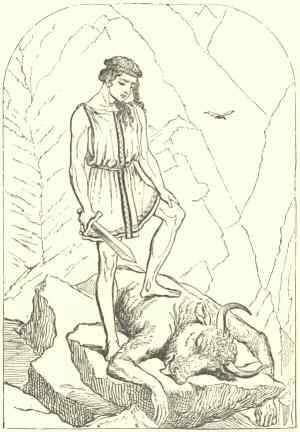
And at last Theseus came up with him, where he lay panting ona slab among the snow, and caught him by the horns, and forcedhis head back, and drove the keen sword through his throat.
Then he turned, and went back limping and weary, feeling hisway down by the clue of thread, till he came to the mouth of thatdoleful place and saw waiting for him, whom but Ariadne!
And he whispered ‘It is done!’ and showed her thesword; and she laid her finger on her lips, and led him to theprison, and opened the doors, and set all the prisoners free,while the guards lay sleeping heavily; for she had silenced themwith wine.
Then they fled to their ship together, and leapt on board, andhoisted up the sail; and the night lay dark around them, so thatthey passed through Minos’ ships, and escaped all safe toNaxos; and there Ariadne became Theseus’ wife.
p. 214PART IV
HOW THESEUS FELL BY HIS PRIDE
But that fair Ariadne never came to Athens with herhusband. Some say that Theseus left her sleeping on Naxosamong the Cyclades; and that Dionusos the wine-king found her,and took her up into the sky, as you shall see some day in apainting of old Titian’s—one of the most gloriouspictures upon earth. And some say that Dionusos drove awayTheseus, and took Ariadne from him by force: but however that maybe, in his haste or in his grief, Theseus forgot to put up thewhite sail. Now Ægeus his father sat and watched onSunium day after day, and strained his old eyes across the sea tosee the ship afar. And when he saw the black sail, and notthe white one, he gave up Theseus for dead, and in his grief hefell into the sea, and died; so it is called the Ægean tothis day.
And now Theseus was king of Athens, and he guarded it andruled it well.
For he killed the bull of Marathon, which had killedAndrogeos, Minos’ son; and he drove back the famousAmazons, the warlike women of the East, when they came from Asia,and conquered all Hellas, and broke into Athens itself. ButTheseus stopped them there, and conquered them, and tookHippolute their queen to be his wife. Then he went out tofight against the Lapithai, and Peirithoos their famous king: butwhen the two heroes came face to face they loved each other, andembraced, and became noble friends; so that the friendship ofTheseus and Peirithoos is a proverb even now. And hegathered (so the Athenians say) all the boroughs of the landtogether, and knit them into one strong people, while before theywere all parted and weak: and many another wise thing he did, sothat his people honoured him after he was dead, for many ahundred years, as the father of their freedom and theirlaws. And six hundred years after his death, in the famousfight at Marathon, men said that they saw the ghost of Theseus,with his mighty brazen club, fighting in the van of battleagainst the invading Persians, for the country which heloved. And twenty years after Marathon his bones (they say)were found in Scuros, an isle beyond the sea; and they werebigger than the bones of mortal man. So the Atheniansbrought them home in triumph; and all the people came out towelcome them; and they built over them a noble temple, andadorned it with sculptures and paintings in which we are told allthe noble deeds of Theseus, and the Centaurs, and the Lapithai,and the Amazons; and the ruins of it are standing still.
But why did they find his bones in Scuros? Why did henot die in peace at Athens, and sleep by his father’sside? Because after his triumph he grew proud, and brokethe laws of God and man. And one thing worst of all he did,which brought him to his grave with sorrow. For he wentdown (they say beneath the earth) with that bold Peirithoos hisfriend to help him to carry off Persephone, the queen of theworld below. But Peirithoos was killed miserably, in thedark fire-kingdoms under ground; and Theseus was chained to arock in everlasting pain. And there he sat for years, tillHeracles the mighty came down to bring up the three-headed dogwho sits at Pluto’s gate. So Heracles loosed him fromhis chain, and brought him up to the light once more.
But when he came back his people had forgotten him, and Castorand Polydeuces, the sons of the wondrous Swan, had invaded hisland, and carried off his mother Aithra for a slave, in revengefor a grievous wrong.
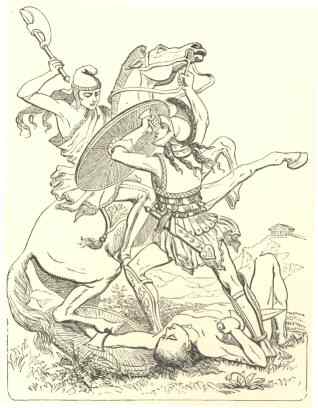
So the fair land of Athens was wasted, and another king ruledit, who drove out Theseus shamefully, and he fled across the seato Scuros. And there he lived in sadness, in the house ofLucomedes the king, till Lucomedes killed him by treachery, andthere was an end of all his labours.
So it is still, my children, and so it will be to theend. In those old Greeks, and in us also, all strength andvirtue come from God. But if men grow proud andself-willed, and misuse God’s fair gifts, He lets them gotheir own ways, and fall pitifully, that the glory may be Hisalone. God help us all, and give us wisdom, and courage todo noble deeds! but God keep pride from us when we have donethem, lest we fall, and come to shame!
theend
Printed byR. & R. Clark, Edinburgh.
Footnotes
[96] In the Elgin Marbles.
[130a] The Danube.
[130b] Between the Crimæa andCircassia.
[130c] The Sea of Azov.
[131a] The Ural Mountains?
[131b] The Baltic?
[132] Britain?
[133] The Azores?